
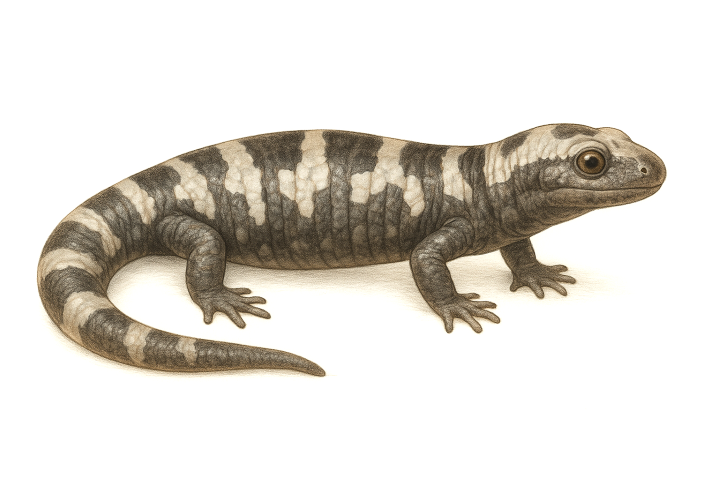
Often described as striking or even handsome for an amphibian, the Marbled Salamander is one of the more eye-catching members of the mole salamander family. Unlike many salamanders that are only seen during the breeding season, this nocturnal species spends most of its life hidden underground — making sightings feel a little extra special. Its bold black and white pattern gives it an unmistakable look and a bit of an edge in the salamander style department.
Size & Physical Appearance
Marbled Salamanders are relatively small, stout-bodied salamanders that typically grow between 3.5 to 4.25 inches long, although some adults can approach 5 inches.
The most distinctive feature is their bold marbled pattern: a dark black or deep gray body crossed with silvery white or light gray bands across the back and tail. Males are usually more dramatic in color, showing brighter and more contrasting bands. Females may have slightly darker, grayer bands that are less sharply defined.
Juveniles look quite different — they’re dark with light speckles and lack the adults’ characteristic banding, which develops as they mature.
Habitat and Range
Marbled Salamanders are found across the southeastern and eastern United States, from Massachusetts and southern New York down through Florida and west to Illinois, eastern Texas, and Oklahoma.
They prefer moist, forested habitats — think oak-pine woodlands, floodplains, and damp leaf litter near vernal pools. These salamanders are fossorial, meaning they spend much of their life underground or beneath logs, rocks, and debris.
They’re particularly tied to areas with seasonal wetlands or temporary pools that fill with rainwater in the fall and winter, which they use for breeding.
Diet
In the wild, Marbled Salamanders eat a variety of small invertebrates. Their diet includes:
- Earthworms
- Insects like crickets and beetles
- Spiders
- Slugs and other soft-bodied critters
They’re ambush predators that wait patiently in the leaf litter or under logs for prey to wander close. Young larvae are aquatic and feed on tiny aquatic organisms and insect larvae.
Lifespan
In the wild, these salamanders can typically live around 4 to 6 years, though some individuals may live longer under the right conditions. In captivity, with good care, they can live up to 8 to 10 years — but long-term keeping requires very specific habitat needs and isn’t ideal for beginners.
Identification Tips
If you spot a small, stocky salamander with black skin and white or silver crossbands, the Marbled Salamander is a good bet — especially in the eastern US.
To tell them apart from similar species:
- Spotted Salamander: Larger, dark body with yellow or orange spots, not bands.
- Mole Salamander (Ambystoma talpoideum): Also chunky, but much darker overall and lacks the marbled pattern.
- Tiger Salamander: Bigger and more variable in color, but usually has yellow blotches or stripes (not white bands), and ranges farther west.
Marbled Salamanders are also unique in that they breed in the fall, not spring, which is rare among amphibians in their range.
Fun Fact
Unlike most salamanders that lay eggs in water, the Marbled Salamander is a bit of a rebel. Females lay their eggs on dry land in depressions that later fill with rain. The mother guards her eggs — a rare behavior among amphibians. When the rains come and the pool fills, the eggs hatch, giving the Marbled Salamander’s offspring a head start over other amphibians.
That head start is important — it lets their larvae grow larger before predators (and competitors) like frogs and other salamanders show up to the party.
In Summary
Marbled Salamanders may not be as commonly seen as frogs during summer hikes, but their bold appearance and unique life history make them one of the hidden gems of the forest floor. Whether you’re exploring a quiet woodland in fall or flipping a log in a moist ravine, keep your eyes peeled — this little black-and-white beauty might just be underneath.