
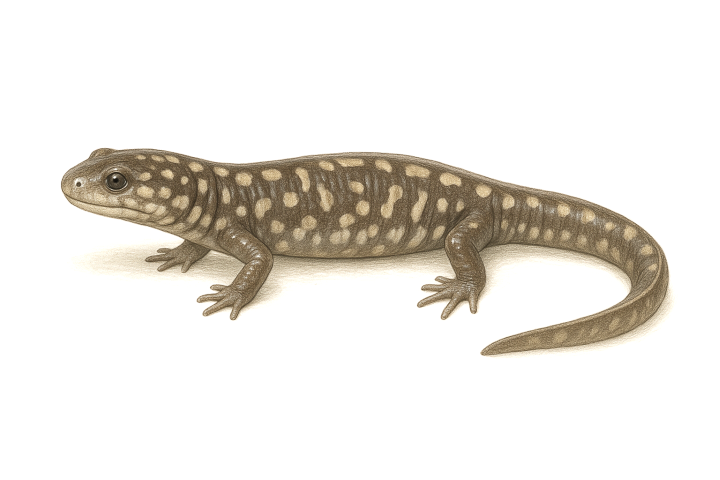
The Reticulated Flatwoods Salamander is a rare and secretive amphibian with a striking name to match its unique look. Native to the southeastern United States, this salamander is most famous for its beautiful silvery reticulated pattern — think of it like nature’s version of a black and white maze, painted right on its body.
Unfortunately, it’s also one of the rarest salamanders in the country, and its numbers have declined sharply due to habitat loss. So spotting one in the wild is like winning the amphibian lottery.
Size & Physical Appearance
Adult Reticulated Flatwoods Salamanders usually grow to about 4 to 5.5 inches long from snout to tail tip. They have long, slender bodies and relatively short legs, with a tail that makes up almost half of their total length.
Their most eye-catching feature is the dark brown to black body covered in a light gray or silvery white reticulated (net-like) pattern. This intricate pattern is what sets them apart visually from their more common relatives.
Juveniles are usually darker and show less of the striking pattern, which becomes more visible as they mature. Males and females look pretty similar, but males tend to have slightly more robust forelimbs during the breeding season.
Habitat and Range
Reticulated Flatwoods Salamanders are found in a very limited range in the southeastern United States. Historically, they inhabited parts of the Florida Panhandle and southern Georgia, but today their known wild populations are extremely fragmented and mostly located in specific areas of Florida and southwestern Georgia.
They live in longleaf pine flatwoods and savannas, ecosystems that were once widespread but are now among the most heavily altered in the region. These salamanders need temporary wetlands — such as seasonal ponds that dry out in summer — for breeding, and moist, sandy uplands with lots of leaf litter or ground cover for adult life.
They are typically found at low elevations, sticking to flat or gently rolling terrain.
Diet
These salamanders are carnivorous, like most amphibians. In the wild, they mainly feed on small invertebrates such as insect larvae, ants, beetles, spiders, centipedes, and worms.
Larvae — which are aquatic — will eat aquatic insects, tiny crustaceans, and other small aquatic creatures. As adults, they hunt by night and spend much of their time hidden under vegetation, logs, or in burrows.
Lifespan
In the wild, Reticulated Flatwoods Salamanders are thought to live around 5 to 10 years, although specific data is limited due to how elusive they are. In captivity, they may live slightly longer with optimal care, but this species is rarely, if ever, kept in captivity outside of scientific programs.
Identification Tips
Telling the Reticulated Flatwoods Salamander apart from other salamanders can be tricky unless you know what to look for.
Here are a few pointers:
- Pattern: The most distinctive feature is its fine, silvery-white reticulated pattern on a dark background. This is more intricate and net-like than the bold stripes or blotches seen in other species.
- Similar species: The Frosted Flatwoods Salamander (Ambystoma cingulatum) is closely related and looks similar but typically has thicker bands or speckles rather than the tight reticulated webbing.
- Where you find it: If you’re outside the small known range, you’re probably looking at a different species of mole salamander. Habitat and geography are big clues with this one.
If you think you’ve found one (which is unlikely, given their rarity), it’s best to get photos and report it to a local wildlife agency — they’re protected under the Endangered Species Act.
Fun Fact
Here’s a cool twist: adult Reticulated Flatwoods Salamanders spend most of their lives underground. They live in crayfish burrows or other small tunnels in sandy soil, sometimes going months without being seen. They only come out during key times like the breeding season in late fall or early winter — often after a heavy rain.
That’s part of why they’re so rarely encountered. Most people have never seen one, even in places where they still exist.
Wrap-Up
The Reticulated Flatwoods Salamander is a beautiful and mysterious creature that plays a big role in its fragile ecosystem. Even though you’re not likely to bump into one, knowing it’s out there matters — and protecting its habitat helps countless other species, too.
If you’re visiting the longleaf pine forests of the Southeast, take a quiet moment at the edge of a seasonal wetland. Who knows? You just might be near one of the rarest salamanders in America.