
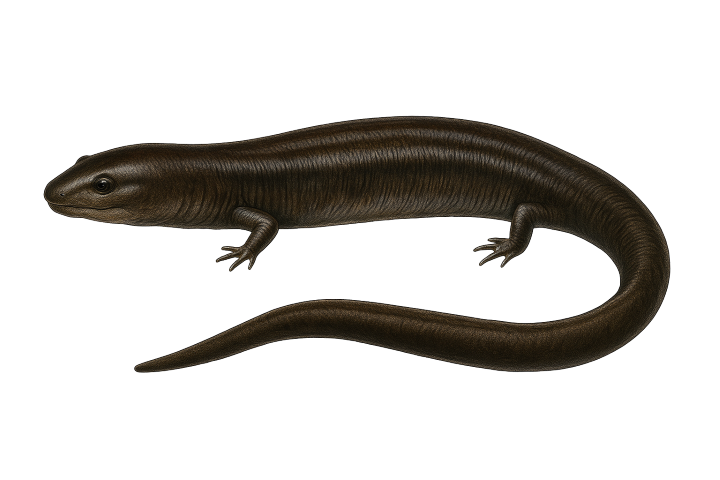
If you’ve never heard of the Two-toed Amphiuma, you’re not alone — this slippery character tends to keep a low profile. But once you meet one, you won’t forget it. Picture a giant eel or oversized salamander with tiny, almost comical legs and the ability to stay underwater for hours. The Two-toed Amphiuma is one of the largest amphibians in North America, and it’s full of surprises.
Size & Physical Appearance
Two-toed Amphiumas are big. Adults typically reach 14 to 30 inches long, with some even stretching over 3 feet. Their long, cylindrical bodies are dark gray to black on top, with a lighter gray underside. They’re smooth-skinned and slimy, which helps them glide through the water.
Despite their size, they have extremely small limbs — each with just two toes (hence the name). Their legs are so reduced that they aren’t much help for walking on land, but they’re visible if you look closely. Males and females look similar, and juveniles resemble adults, just smaller.
Habitat and Range
You’ll find the Two-toed Amphiuma in the southeastern United States, mostly in lowland areas and coastal plains. Their range includes parts of:
- Florida
- Georgia
- Alabama
- Mississippi
- South Carolina
- Louisiana
- Eastern Texas
They prefer slow-moving, shallow waters like swamps, marshes, ditches, and floodplain forests. Amphiumas spend nearly their entire lives in water and rarely venture far from it. They’re especially fond of muddy bottoms where they can hide during the day.
Diet
These critters are nocturnal predators with a big appetite. At night, they come out to hunt and eat a wide range of prey, including:
- Insects and insect larvae
- Small fish
- Crayfish
- Snails
- Other amphibians (even smaller amphiumas!)
They have powerful jaws for an amphibian and can deliver a surprisingly strong bite. Amphiumas use quick strikes to grab prey and swallow it whole.
Lifespan
In the wild, Two-toed Amphiumas can live for 10 to 15 years. In captivity, some have lived over 20 years with proper care. That’s a pretty long life for an amphibian.
Identification Tips
Amphiumas can be confused with other large aquatic creatures, especially:
- Sirens – These are similar-looking eel-like salamanders but have external gills and only front legs (with 3 or 4 toes).
- Eels – Unlike amphiumas, eels are fish, not amphibians, and lack limbs entirely.
- Water snakes – Snakes have scales and no limbs, while amphiumas have smooth skin and four tiny legs.
To positively ID a Two-toed Amphiuma, look for:
- Smooth, gray-black skin
- Long body with four tiny legs (each with 2 toes)
- No external gills (they have internal lungs and breathe air)
- Nocturnal behavior and a preference for still or slow-moving water
Fun Fact
Two-toed Amphiumas can actually survive dry periods by burrowing into mud and sealing themselves in a moist cocoon. They go into a state of torpor (kind of like hibernation) until the water returns. Nature’s version of waiting out a dry spell!
Curious About Amphiumas?
They’re not the kind of salamander you’ll find hopping across your backyard, but that just makes the Two-toed Amphiuma even more fascinating. If you’re lucky enough to spot one in the wild (usually at night or after heavy rains), remember to observe from a distance. These animals are secretive and not often seen, which makes an encounter extra special.
Just keep your fingers out of reach — they do have a surprisingly strong bite for something that looks like a slippery tube with legs!