
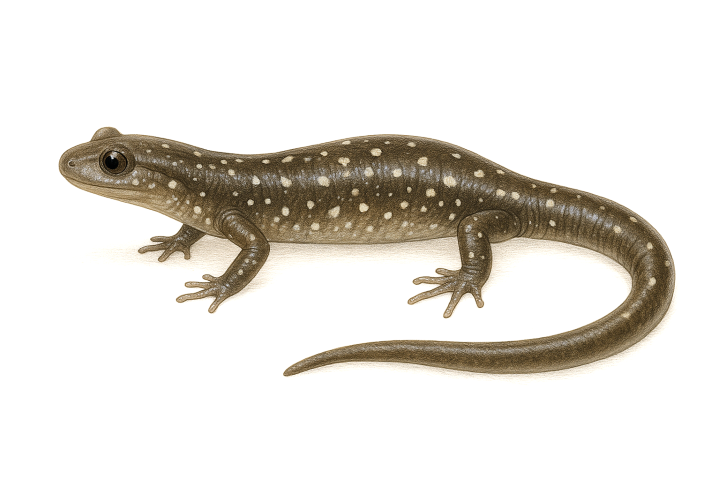
The Kiamichi Slimy Salamander is a rare and secretive amphibian that lives in just a small corner of the United States. If you’ve never heard of it, you’re not alone — this species has a really limited range and tends to keep a low profile. But among salamander fans, it’s a special one. Why? Because it’s only found in a very specific part of southeastern Oklahoma and western Arkansas, making it what scientists call “endemic” to that area.
It also gets its name from the slick, sticky substance it secretes when threatened — a handy defense trick that makes it hard for predators (or curious humans) to get a grip!
Size & Physical Appearance
The Kiamichi Slimy Salamander is a medium-sized member of the Plethodon family, measuring around 4 to 6 inches long from nose to tail. It’s black overall, with tiny scattered white or silvery spots along its sides, back, and limbs — kind of like a starry night sky.
The body is slender, the tail is long, and like other woodland salamanders, it lacks lungs and breathes through its skin. You won’t see any dramatic differences between males and females, though males may have slightly more pronounced glands on the underside of their chins during the breeding season.
Habitat and Range
This salamander is only found in a small part of the Kiamichi Mountains and surrounding ranges of southeastern Oklahoma and the far western edge of Arkansas. That’s it — nowhere else.
It lives in moist, forested habitats, especially mature hardwood forests with plenty of leaf litter, decaying logs, and rocky outcrops. These shady, damp environments are crucial because the Kiamichi Slimy Salamander needs to keep its skin moist to breathe.
You’re most likely to find them at moderate to higher elevations in these mountain ranges, especially in spots that stay cool and damp even in summer.
Diet
This little carnivore spends its nights hunting for small invertebrates. Its diet includes:
- Insects like ants, beetles, and moths
- Spiders and mites
- Worms and other soft-bodied critters
It’s an opportunistic feeder, meaning it’ll eat whatever small prey is available. Because it’s often hiding in the leaf litter or under logs, it comes across a lot of crawling invertebrates.
Lifespan
In the wild, the Kiamichi Slimy Salamander can live for up to 10 years, though many factors like drought or habitat disturbance might shorten that. In captivity, plethodontid salamanders have been known to live even longer — sometimes more than 12 years — but this particular species is rarely kept or studied in zoos or labs.
Identification Tips
It can be tricky to tell the Kiamichi Slimy Salamander apart from other slimy or woodland salamanders, especially if you’re in a region where several live close together. Here are a few things to look for:
- Range is key — if you’re not in southeast Oklahoma or western Arkansas, it’s probably not this species.
- Compared to the Western Slimy Salamander (Plethodon glutinosus), the Kiamichi tends to have smaller and more scattered spots.
- Its overall coloration is usually darker, with less variation in the spotting pattern.
Behavior can also be a hint — these salamanders tend to avoid coming out during the day and will retreat quickly if disturbed.
Fun Fact
When threatened, the Kiamichi Slimy Salamander can secrete a from its skin that’s so sticky, even snakes have trouble swallowing them. This mucus isn’t just gross — it’s also a super-effective defense mechanism that gives them time to escape.
Some researchers have even studied the stickiness of this slime to better understand natural adhesives!
In Summary
The Kiamichi Slimy Salamander is a little-known but fascinating part of the southern U.S. forest ecosystem. With its limited range, starry-speckled skin, and gooey defense system, it definitely deserves more attention. If you’re exploring the mountains of southeastern Oklahoma or nearby Arkansas, keep an eye out under rocks or logs — just remember to place those back gently.
And if you find one? Consider yourself lucky; very few people ever do!