
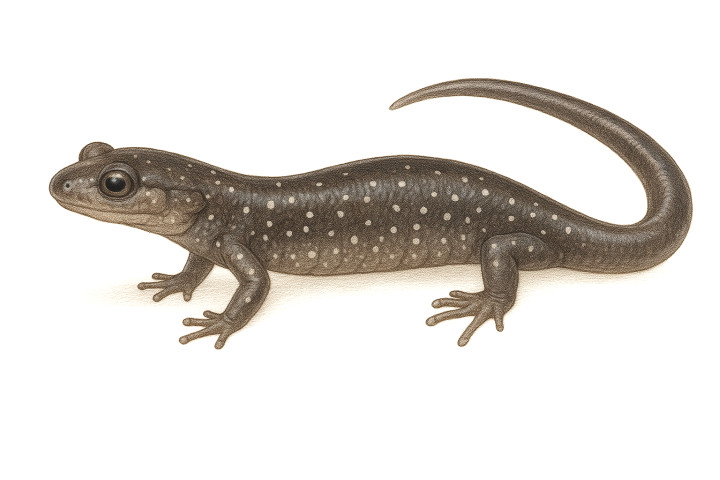
Meet the Southeastern Slimy Salamander, a secretive little amphibian that plays hard to get. Named for the sticky slime it uses as a defense mechanism, this salamander is more often heard rustling under leaves than seen out in the open. It’s part of the Plethodon group — also called lungless salamanders — which means it breathes through its skin and the lining of its mouth. Yeah, it’s pretty amazing.
Size & Physical Appearance
These salamanders are on the smaller side, usually ranging from 4 to 6 inches long, including the tail. Their bodies are slender with smooth black skin, flecked with tiny white or silver spots — kind of like a night sky. Some individuals may look more speckled than others depending on where they’re from.
There’s not much in the way of flashy differences between males and females, at least not to the casual observer. Juvenile salamanders tend to be skinnier and may show less patterning at first, but they catch up as they grow.
Habitat and Range
The Southeastern Slimy Salamander is found in the Southeastern United States, mostly in parts of southern Alabama, Georgia, and the Florida Panhandle. It prefers shady, moist habitats in hardwood forests, often with plenty of leaf litter, rotting logs, or rocky crevices to hide in. You’re most likely to find one if you flip over a log on a damp day — just remember to put the log back gently afterwards.
Elevation-wise, they’re usually found in lower-elevation forests, rarely up in the mountains. They don’t like dry conditions, so they stick close to places with steady moisture.
Diet
These salamanders are all about the small stuff. Their diet includes insects, spiders, worms, snails, and other tiny invertebrates. They hunt at night, using their sticky tongues to snag prey. Think of them as little forest-floor ninjas that help keep insect populations in check.
Lifespan
In the wild, Southeastern Slimy Salamanders can live for around 5 to 10 years. In captivity (though they’re rarely kept as pets), their lifespan can stretch a bit longer with ideal conditions.
Identification Tips
It’s easy to confuse this salamander with other black-and-white speckled species in the Plethodon glutinosus complex, which are all very similar in appearance. Here’s how to narrow it down:
- Range is key: If you’re in southern Georgia, Alabama, or the Florida Panhandle, there’s a good chance you’ve got a P. grobmani.
- Spotting patterns: Southeastern Slimy Salamanders usually have small, evenly scattered white or silver spots. Other species might have larger blotches or fewer markings.
- Habitat overlaps: Keep in mind that some slimy salamanders overlap in range and look nearly identical. Sometimes, genetic testing is the only truly accurate way to tell them apart. But for casual observation, location and patterning are your best tools.
Fun Fact
The slime in “Slimy Salamander” isn’t just a weird gross-out feature — it’s an actual defense weapon. When threatened, these salamanders can secrete a thick, sticky mucus from their skin that can gum up the mouth of a predator, giving the salamander time to escape. Even snakes hate it!
It’s also remarkably adhesive; researchers have studied it as a model for natural glues — yes, salamander slime turning into a science project!
Final Thoughts
The Southeastern Slimy Salamander may not be flashy, but it plays an important role in its forest home. It helps control insect populations, enriches the food web, and offers a glimpse into the incredible diversity of salamanders most people never notice.
If you’re out exploring in the Southeast, keep an eye (and ear) out for a little black salamander slinking under a log. Just handle it gently if you must, and definitely wash your hands afterward — that slime is no joke.