
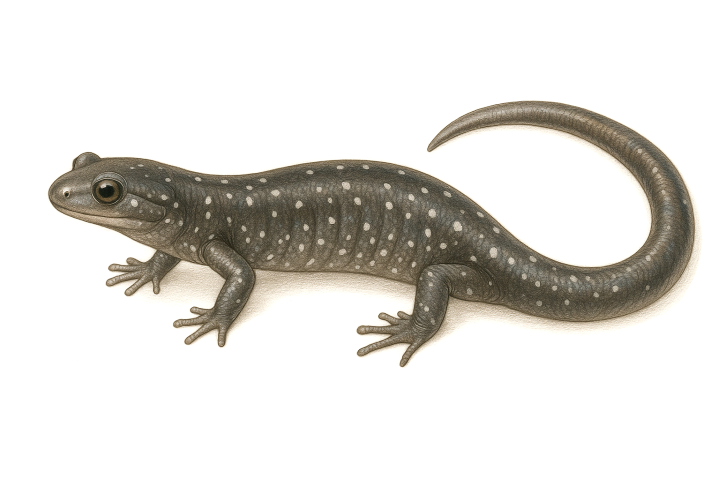
The Northern Slimy Salamander definitely lives up to its name. This secretive amphibian is known for the sticky, glue-like slime it produces when threatened — a clever way to escape predators. Found in forested parts of the eastern United States, it’s one of the most commonly encountered woodland salamanders, though it’s still pretty shy and loves to stay hidden under logs, rocks, and leaf litter.
Size & Physical Appearance
Northern Slimy Salamanders are medium-sized for a salamander. Adults typically measure between 4 and 6.75 inches long, though some may reach up to 7 inches.
Their bodies are black or very dark gray with a scattering of white or silvery spots, which can sometimes look bluish or metallic. These spots often cluster along the sides and back, though the pattern can vary depending on the individual and region.
They have a stout body, broad head, and a noticeably slimy skin. Males and females look pretty similar to the naked eye, though males may have slightly broader heads during the breeding season. Juveniles tend to look like miniature adults but with more noticeable spotting.
Habitat and Range
Northern Slimy Salamanders love cool, moist forest habitats. They especially thrive in deciduous woodlands with plenty of shade and cover — think areas with lots of rotting logs, rocks, and leaf litter to hide under and keep their skin damp.
They range across much of the eastern United States, from southern New York and western Connecticut, down through the Appalachian Mountains and into parts of the Southeast, including Tennessee, Kentucky, Virginia, and North Carolina. They generally stick to elevations between 500 and 3000 feet, especially in mountainous regions.
Diet
These salamanders are insectivores and have a varied diet. In the wild, they eat:
- Ants
- Termites
- Beetles
- Spiders
- Earthworms
- Small snails and other invertebrates
They hunt mostly at night, creeping out of their hiding spots to forage once the environment is cool and damp. Their sticky tongue helps them catch prey quickly.
Lifespan
In the wild, the Northern Slimy Salamander can live for around 10 to 15 years, though some individuals may live longer. In captivity with proper care, they may live slightly longer, but they are not commonly kept as pets due to their specific habitat needs and reclusive nature.
Identification Tips
It’s easy to confuse the Northern Slimy Salamander with other woodland salamanders, especially other species in the Plethodon genus. Here’s how to tell them apart:
- White spots on a black body: This is a defining feature, but be aware it varies in intensity.
- No red or yellow coloration: If you spot bold red, yellow, or orange coloring, it might be a different species like a red-backed or two-lined salamander.
- Moist, shiny skin: Their skin always looks wet and a bit glossy, and it feels sticky or slimy to the touch.
- No costal grooves visible like in some related species: You may notice fewer visible ridges along the sides compared to, say, a red-backed salamander.
Also, keep in mind that slimy salamanders don’t have lungs — instead, they breathe entirely through their skin and the tissues in their mouths, which is why maintaining moist skin is so important for them.
Fun Fact
The “slimy” part of their name isn’t just for show. When threatened, the Northern Slimy Salamander can secrete a sticky, glue-like substance from its tail. This slime is so adhesive that it can actually trap small predators or at least make it hard for them to get a grip. Some predators even abandon their attack when they end up coated in the goo!
Wrap-Up
Though they’re not often seen out in the open, the Northern Slimy Salamander is a fascinating and important part of eastern forest ecosystems. They help control insect populations and are considered a good sign of a healthy, undisturbed woodland.
If you’re out hiking in the Appalachians or leaf-flipping in a shady forest in the East, keep an eye out for these shy, spotted salamanders — just remember to be gentle and leave them where you found them. Their habitat is home sweet home, and they’re happiest left undisturbed.