
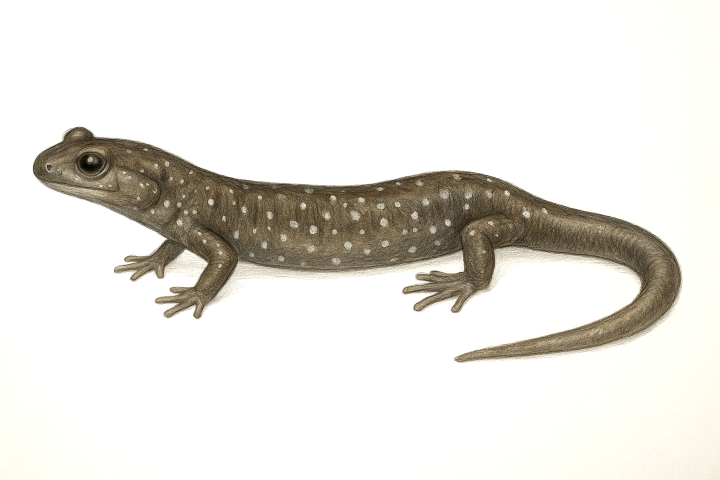
The Atlantic Coast Slimy Salamander is one of those creatures that’s easy to overlook — until you actually find one. Shiny black skin dotted with white or silver flecks gives it a starry-night look, and true to its name, it’s definitely slimy. That mucus coating isn’t just gross — it’s a defense mechanism that helps it avoid predators. If you’re exploring forests along the southeastern U.S. coast and peel back a log or rock, you just might see one hiding underneath.
Size & Physical Appearance
These slimy salamanders are medium-to-large for their group. Adults usually measure between 4 to 6.5 inches long from nose to tail tip.
Their base color is a deep black, and they’re covered in tiny white or silver spots scattered across the back and sides. These markings can be sparse or dense, and they sometimes form a faint salt-and-pepper pattern. The amount and brightness of the spotting can vary a lot between individuals.
Males and females look similar, though males may have slightly broader heads during breeding season. Juveniles look like smaller versions of adults but sometimes have brighter markings.
Habitat and Range
The Atlantic Coast Slimy Salamander lives along the southeastern Atlantic coastal plain, from southeastern Virginia down through parts of the Carolinas into northern Georgia and Florida.
These salamanders prefer moist hardwood or mixed forests, especially areas with dense leaf litter and plenty of rotting logs or rocks to hide under. They are terrestrial, meaning they live on land their whole lives — unlike many amphibians, they don’t have a larval stage in water.
You’ll mostly find them at low elevations, especially in coastal plain habitats that are damp and shady.
Diet
Atlantic Coast Slimy Salamanders are nocturnal hunters that come out at night to search for small invertebrates.
Their diet includes:
- Ants
- Beetles
- Worms
- Spiders
- Slugs and snails
They use a sticky tongue to snatch prey quickly. They’re not picky — basically, if it fits in their mouth and moves, it’s on the menu.
Lifespan
In the wild, these salamanders may live up to 10 years, though many don’t make it that long. In captivity, with perfect conditions, they may live even longer — potentially around 15 years — but most of what we know comes from studies in wild populations.
Identification Tips
Telling the Atlantic Coast Slimy Salamander apart from other members of the Plethodon genus can be tricky — several species look similar.
Here’s what to look for:
- Spots and speckles: Look for white or silvery spots scattered across the back and sides — these vary in number but are a key clue.
- Lack of red or bright color: Unlike the Red-backed Salamander, this species never has a red stripe or patch.
- Body texture: That shiny, slightly sticky skin is a giveaway — it’s where the “slimy” name comes from.
- Location matters: If you’re along the Atlantic Coastal Plain in the southeastern U.S., you’ve probably found Plethodon chlorobryonis rather than one of its close cousins.
If you’re unsure, comparing range and spotting patterns with a field guide can help. Local herpetology groups are also great resources.
Fun Fact
The “slime” on these salamanders isn’t just any old mucus — it’s actually sticky enough to gum up a predator’s mouth. In fact, some researchers compare it to glue! If a snake or bird tries to eat one, the goo can make the salamander literally too much trouble to handle, giving it time to escape.
Interested in Finding One?
If you’re out hiking or in your backyard near coastal forests, your best bet is checking under logs, rocks, or leaf piles — but please be careful. Gently lift and return any covers, and always handle amphibians with clean, damp hands (or, better yet, don’t handle them at all). These salamanders are sensitive to skin oils, lotions, and heat.
The Atlantic Coast Slimy Salamander is a fascinating, often overlooked part of the forest ecosystem — and a great reminder of just how much life hides in plain sight on the forest floor.