
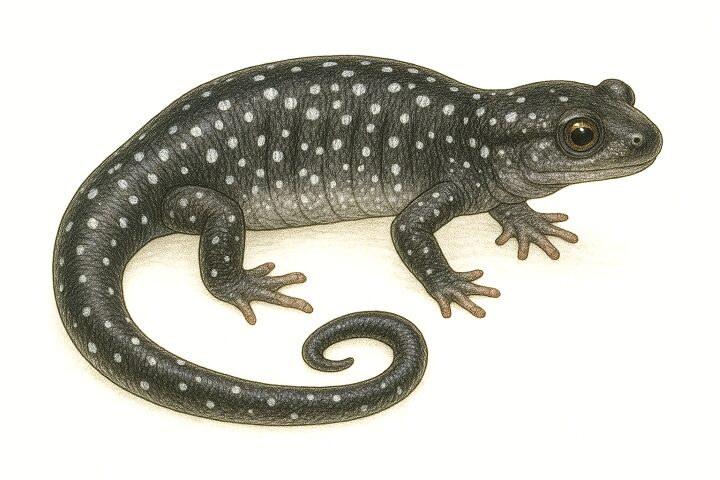
The Western Slimy Salamander might not have the flashiest colors, but what it lacks in looks, it makes up for in personality. This secretive amphibian gets its name from the thick, sticky slime it produces when threatened — a natural defense that makes it nearly impossible for predators to grab onto. If you’re lucky enough to spot one, count yourself lucky; they spend most of their time hiding under rocks, logs, or leaf litter in shaded forests.
Size & Physical Appearance
Adult Western Slimy Salamanders usually range from 4 to 6.5 inches long, though some can grow a bit larger. Their bodies are generally black with scattered white or silver spots, which can vary in density depending on location. These speckles might concentrate along the sides or be lightly sprinkled across the back, giving each salamander a slightly different “starry-night” pattern.
Their skin is smooth and moist — typical of salamanders — but it’s also known for that characteristic sticky mucus that gives the species its name. Males and females look pretty similar, and juveniles resemble smaller versions of adults, though their spots may be fainter and their body proportions slightly different.
Habitat and Range
Western Slimy Salamanders are forest dwellers through and through. They thrive in moist, shaded environments — think mixed hardwood forests with plenty of ground cover like rocks, logs, and leaf litter to hide under. They’re most commonly found in:
- Missouri
- Arkansas
- Eastern Oklahoma
- Eastern Kansas
- Parts of eastern Texas
They often prefer rocky hillsides and valleys. Elevation-wise, they’re generally found from lowland forests up to moderate elevations, particularly where limestone outcrops and caves are present. They’re part of a group sometimes referred to as the “slimy salamander complex,” which means they can overlap in range with similar species — but more on that below.
Diet
These salamanders are nocturnal hunters and feed on a wide variety of small invertebrates. Their diet includes:
- Insects
- Spiders
- Earthworms
- Snails
- Other small arthropods
They rely on stealth and their excellent sense of smell to search out meals under cover of darkness. You won’t catch them munching during the day — they’re strictly night owls when it comes to feeding.
Lifespan
In the wild, Western Slimy Salamanders typically live around 5 to 10 years. In captivity, with ideal conditions (cool temperatures, high humidity, and clean environments), they may live slightly longer. However, these salamanders are not commonly kept as pets, mainly because they stress easily and require very specific environmental conditions to thrive.
Identification Tips
Because the Western Slimy Salamander belongs to a group of very similar-looking species, telling them apart can be a bit tricky — even for herpetologists. However, there are a few helpful tips:
- Look for white or silver spotting on a black body. Some individuals have a salt-and-pepper look while others are more sparsely speckled.
- The species tends to be larger than other spotted Plethodon salamanders in the region.
- If you’re in the Ozarks or nearby areas and find a salamander that sticks like glue when you try to pick it up — you’re likely holding a Western Slimy Salamander.
Similar species include the Northern Slimy Salamander (Plethodon glutinosus) and the Rich Mountain Salamander (Plethodon ouachitae), both of which share overlapping traits and habitats. Range and subtle pattern differences are usually the best clues.
Fun Fact
Western Slimy Salamanders lay their eggs in hidden underground chambers, and here’s the cool part — the mother stays with the eggs and guards them until they hatch. That’s some serious parental investment for a small amphibian. The young hatch fully formed and skip the tadpole stage entirely, ready to start sliming like the adults.
Whether you’re hiking through a Missouri forest or flipping rocks in Arkansas, keep an eye out for this quiet, sticky little creature. The Western Slimy Salamander may not shout for attention, but once you know what you’re looking for, it’s a fascinating part of America’s amphibian diversity. Just remember: no touching unless you’re a trained naturalist — their skin is sensitive, and that slime is no joke!