
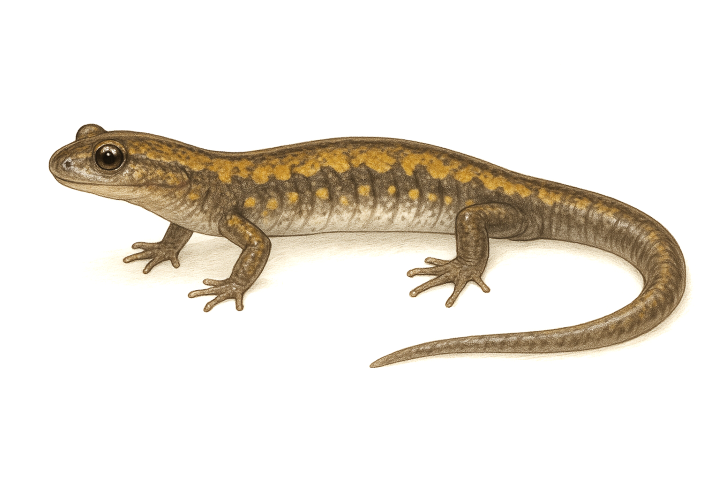
The Tellico Salamander is a small, secretive amphibian that lives in the shaded forests of the southern Appalachian Mountains. What makes it stand out? Its shimmering, golden-flecked body and its quiet, mountaintop lifestyle. First described in 2000, this salamander is still relatively new to science, which makes it a fascinating species for nature lovers and researchers alike. If you’re hiking in the right spot, you just might catch a glimpse of one beneath a log or rock.
Size & Physical Appearance
Tellico Salamanders are slender and on the smaller side, typically ranging from 2.5 to 5 inches long, including the tail. Their most distinctive feature is the iridescent gold or bronze flecking scattered across a dark gray to black body, giving them a slightly speckled, almost magical appearance under the right light.
They have a fairly standard salamander shape with a broad head, relatively short legs, and a long tail. There’s not a big visual difference between males and females, which can make them hard to tell apart unless you’re an expert.
Juveniles usually look like smaller adults but may have slightly duller coloring until they mature.
Habitat and Range
These salamanders are endemic to a very small region in the southeastern U.S., specifically in the Unicoi and Great Smoky Mountains of Tennessee and North Carolinacool, moist hardwood forests and are often found in areas with plenty of cover like logs, rocks, and leaf litter.
They live at mid to high elevations, typically between 2,000 and 5,000 feet. Because they breathe through their skin, they rely on damp habitats with high humidity. You’ll usually find them in undisturbed forests far from heavy human development.
Diet
Like most woodland salamanders, the Tellico Salamander is a carnivore that eats small invertebrates they find among the forest floor. Their diet includes:
- Insects
- Spiders
- Springtails
- Snails
- Worms
They hunt mostly at night or during wet, cool weather. Since they don’t have lungs, they rely on their skin and the lining of their mouth to breathe — so staying moist is crucial not just for survival, but for catching food too.
Lifespan
In the wild, the typical lifespan isn’t well-documented, but researchers estimate that Tellico Salamanders can live up to 10 to 15 years under natural conditions. In captivity, they can live even longer if their environment is carefully maintained.
Identification Tips
The Tellico Salamander is often confused with a few of its close Appalachian cousins, especially the Ocoee Salamander (Plethodon ocoee), which lives in overlapping habitats. Here’s how to tell them apart:
- Coloration: The Tellico has more golden or brassy flecking, especially over its tail and back. Ocoee Salamanders often have more consistent gray or reddish tones and may feature a straight-lined dorsal stripe.
- Location: Geographic location helps. If you’re in the upper Tellico River basin or surrounding mountain ridges, odds are it’s a Tellico Salamander.
- No dorsal stripe: Unlike some relatives, Tellico Salamanders typically lack a noticeable stripe down the back.
If you’re not sure, it’s okay — even herpetologists sometimes need to look at specimens under a microscope or test DNA to be certain!
Fun Fact
This salamander was actually once considered part of another species — the Ocoee Salamander — until studies showed it had unique genetics and coloring. It was officially described as its own species in 2000, making it one of the newer recognized amphibians in the U.S.
Final Thoughts
The Tellico Salamander might be tiny and shy, but it’s part of what makes the Appalachian region so special. It’s a reminder that even in places we think we know well, there are still discoveries to be made. If you’re hiking in its native range, keep your eyes peeled — and always remember to observe without disturbing. These forest jewels are sensitive to changes in moisture and habitat and deserve a safe, wild home.
For nature lovers, this species is a great example of how rich and fragile our mountain ecosystems really are.
Want to see one? Visit during spring or fall after a good rain, and look (gently) under logs or rocks in shady sections of the forest. Just remember to place things back exactly how you found them.