
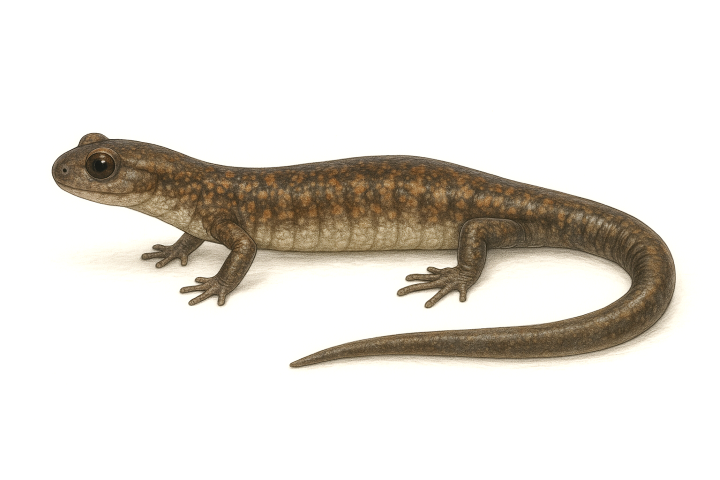
Tucked away in the forests of northern California, the Scott Bar Salamander is one of those rare, little-known amphibians that most people have never heard of — but it’s incredibly cool once you get to know it. It’s a type of lungless salamander, which means it breathes entirely through its skin and the lining of its mouth. What really makes the Scott Bar Salamander stand out is just how localized it is: this species exists in only a very small corner of the world, making it a hidden gem of biodiversity.
Size & Physical Appearance
The Scott Bar Salamander is on the smaller side, typically growing to about 2.5 to 3 inches in total length. It has a slender body and limbs, with a somewhat flattened head.
Color-wise, it’s usually dark brown or black with tiny white or light-colored flecks scattered across its back and sides. You might also notice a subtle reddish or purplish tint in the right light — almost like a shimmer. The underside is usually lighter, often grayish.
There aren’t dramatic differences between males and females, and juveniles tend to look like miniature versions of the adults, though they may be slightly more translucent or dull in color.
Habitat and Range
This salamander is a real homebody. The Scott Bar Salamander is found only in a very limited area of Siskiyou County, California, along the Klamath River near the tiny community of Scott Bar – that’s actually where it gets its name.
It lives in moist, shaded forest habitats, especially in areas with plenty of loose rock, talus slopes (rocky debris), and decaying logs. You’ll most often find it in mature coniferous forests or mixed hardwood forests with a steady supply of ground moisture.
Elevation-wise, it’s usually found between 1,000 to 5,000 feet, where humidity stays high enough to support skin-breathing salamanders.
Because it has such a narrow range and very specific habitat requirements, any changes to its environment (like logging or development) can have a big impact.
Diet
The Scott Bar Salamander is a nighttime hunter. It comes out under the cover of dark to feed on tiny invertebrates like ants, mites, spiders, snails, and small beetles.
It uses its sticky tongue to snap up prey, kind of like a frog, though the movement is subtler and slower. It typically forages on the forest floor or in damp crevices — anywhere it can find a meal that fits in its mouth.
Lifespan
In the wild, lungless salamanders like the Scott Bar could live 10 to 15 years or more, though exact data on this species is limited due to its elusive nature. Because they’re sensitive to stress and changes in humidity, they don’t tend to do well in captivity.
Identification Tips
The Scott Bar Salamander can look similar to other members of the Plethodon genus, especially species like the Siskiyou Mountains Salamander (Plethodon stormi), which is also found in the same general area.
Here are a few ways to tell them apart:
- Size and geography: Scott Bar Salamanders have a very limited range, and if you’re outside that small region near Scott Bar, it’s probably not one.
- Coloration: Look for the fine, white or light speckling and lack of bold stripes. Unlike the Ensatina or some other California salamanders, they don’t have bright warning colors.
- Habitat: Found in talus slopes and rocky forest patches — if you’re flipping rocks in that kind of terrain in Siskiyou County, you’re in the right zone.
If you’re unsure, a photo and a GPS location can help biologists tell species apart, especially in overlapping areas.
Fun Fact
The Scott Bar Salamander doesn’t have lungs at all — it relies entirely on its skin and mouth lining to breathe. That’s why it has to live in cool, damp environments with high humidity. If it dries out, it can’t breathe — literally!
Final Thoughts
This is one of those glorious forest-dwelling creatures that most people never get to see, but it’s an important part of the delicate web of life in northern California. Whether you’re a student, hiker, or parent teaching your kids about nature, the Scott Bar Salamander is a great reminder of how much biodiversity exists — even in a tiny patch of forest.
If you ever explore this region, tread carefully, leave logs and rocks where they are, and keep a lookout. You just might spot one of California’s rarest amphibians.