
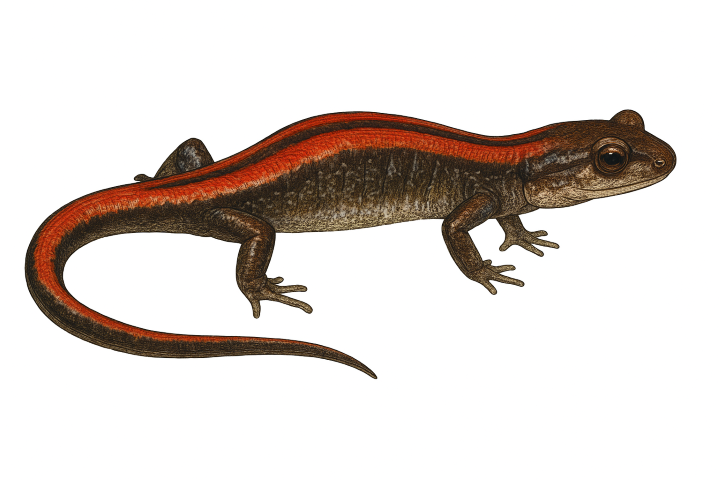
The Western Red-backed Salamander is a small but striking amphibian that’s easy to overlook—unless you know what to look for. With its bold red stripe running down its back, this salamander stands out in the damp forests of the Pacific Northwest. It’s part of a remarkable group known as “lungless salamanders,” meaning it breathes entirely through its skin and the lining of its mouth. Weird, right? It’s a quiet but fascinating creature that plays an important role in the forest ecosystem.
Size & Physical Appearance
These salamanders are pretty small—most adults range from about 2.5 to 4 inches from snout to tail. What really makes them stand out is the bright, brick-red stripe that runs along their back and tail, bordered by darker sides speckled with tiny white flecks. The stripe can vary in shade—some individuals even have more orange or yellow tones.
Males and females look very similar, though males may have slightly broader heads and more prominent nasolabial grooves (these help detect chemical signals). Juveniles look like miniature adults and already have that signature back stripe, although the colors can be duller when they’re young.
Habitat and Range
Western Red-backed Salamanders are true forest dwellers. They love the cool, damp, and shaded environments of coniferous and mixed woodlands. You’ll mostly find them in the Pacific Northwest—particularly in western Washington, western Oregon, and parts of northern California. They can also show up in southern British Columbia.
They typically hang out in moist leaf litter, under rotting logs, rocks, or forest debris. These salamanders tend to live at lower and mid-elevations, though they can be found up to about 3,000 feet in the mountains.
Diet
Western Red-backed Salamanders are opportunistic hunters. Their diet includes small invertebrates like ants, mites, spiders, beetles, and springtails. Basically, if it’s small and crawls around in leaf litter, they’re interested in it.
They hunt mostly at night or during damp, overcast days when the forest floor is moist—conditions that keep their delicate skin from drying out.
Lifespan
In the wild, these salamanders can live for over 8 to 10 years. In captivity, under the right care (and with constant moisture and the right temperature), they can potentially live even longer—though they’re not commonly kept as pets.
Identification Tips
Because several salamanders in the Plethodon genus share similar coloring, it’s worth paying attention to a few details:
- Western Red-backed Salamanders always have a down the back—usually red or rusty—but some can be more orange or tan. The stripe goes all the way onto the tail.
- Compared to the Ensatina salamanders, these have . Ensatinas have what looks like a “pinched” tail near the body.
- Unlike the (Plethodon dunni), which may have a similar dorsal stripe, the red-backed also has along the sides.
They’re small, so you’ve got to look closely—but once you see that solid red stripe and those speckled sides, you know you’ve found a Western Red-backed.
Fun Fact
These salamanders don’t have lungs at all—they breathe entirely through their . That’s why they need to live in damp environments. If they dry out, they can’t breathe and will die. It’s a wild adaptation that really makes you appreciate how specialized (and vulnerable) these guys are.
Wrap-Up
The Western Red-backed Salamander might not be flashy like a treefrog or giant like a bullfrog, but it’s one of the quiet stars of the forest floor. It’s a great example of how every little creature, even the ones hidden under logs, plays a role in keeping ecosystems healthy.
Next time you’re walking through a damp Northwest forest, take a pause and check under a fallen log (gently, and always replace it!). You might just find one of these red-striped salamanders tucked away underneath—a tiny, living piece of the forest puzzle.