
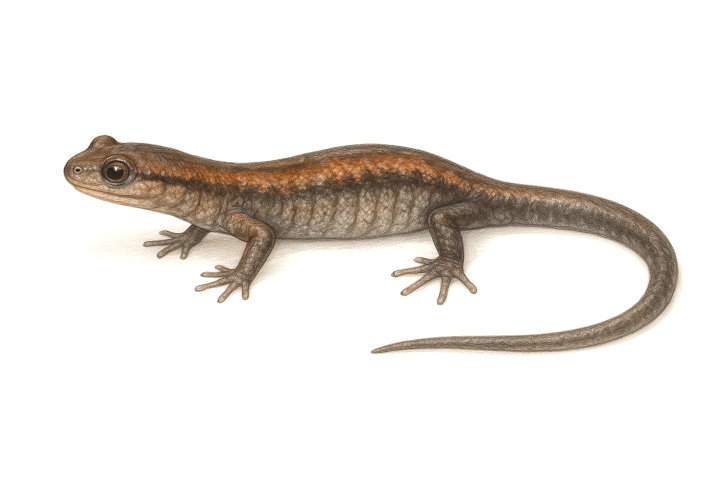
The Larch Mountain Salamander is a mysterious little creature that lives a quiet life in the mossy forests of the Pacific Northwest. What makes this salamander so fascinating is not only its very limited range — it’s found in just a small part of Washington and Oregon — but also the fact that it doesn’t have lungs. Yep, this salamander breathes entirely through its skin and mouth lining, which makes its moist, forest home essential for survival.
Size & Physical Appearance
These salamanders are pretty small. Adults usually range from 2 to 2.5 inches long from snout to tail, though some can reach up to 3 inches. They have a slender body with long legs and a narrow head.
Their coloring can help them blend right into the forest floor. Most have a reddish to orange-brown stripe running down the back, often with tiny flecks or spots. The sides are usually dark brown or black, sometimes with lighter speckling. The underside tends to be pale or pinkish.
Juveniles look like tiny versions of the adults, though their colors may be less vivid at first. There’s not much obvious difference between males and females without close examination, which is usually best left to the experts.
Habitat and Range
The Larch Mountain Salamander is what scientists call an endemic species, meaning it only lives in a very specific region. You’ll find it in parts of south-central Washington and northwestern Oregon, mostly near the Columbia River Gorge and surrounding areas.
It prefers cool, moist forested slopes, often in rocky talus and moss-covered lava flows. Elevation matters: this salamander tends to live between 500 and 4,000 feet above sea level. You’ll often find them hiding under rocks or logs during the day, especially near volcanic rock outcrops.
Diet
Larch Mountain Salamanders are small, but they’re active hunters at night. They eat a variety of tiny invertebrates, including ants, springtails, mites, and small beetles. They use their sticky tongues to snatch prey, kind of like their frog cousins.
There’s nothing especially exotic about their diet, but watch one on the hunt, and you’ll see just how quick and precise they can be for such a tiny animal.
Lifespan
In the wild, these salamanders can live up to around 10 years, though it’s hard to pin down an exact average because they’re reclusive and tough to monitor over time. In captivity, where conditions are constant, they may live a little longer, though this species isn’t commonly kept as a pet or in labs.
Identification Tips
The Larch Mountain Salamander can sometimes be confused with a few of its close relatives, especially the Western Red-backed Salamander (Plethodon vehiculum), which also has a red stripe down the back.
Here’s what to look for:
- Stripe: Larch Mountain Salamanders often have a more broken or blotchy dorsal stripe, while the Western Red-backed has a smooth, straight one.
- Habitat: If you’re hiking in lava rock areas within its limited range, Larch Mountain is more likely.
- Shape: They’re more slender than some similar species, with a slightly flattened body and long legs.
Always check with a regional herpetology guide if you’re unsure — amphibian ID can be tricky!
Fun Fact
Here’s something wild — because the Larch Mountain Salamander breathes through its skin, it has to stay moist to survive. That means it’s incredibly sensitive to changes in humidity and temperature. It’s also why it’s rarely seen during the heat of summer or in dry conditions. In some small forest pockets, entire populations of these salamanders may live out their lives within a few square meters!
Final Thoughts
If you’re hiking in the Pacific Northwest and flipping over logs or rocks (always carefully, and be sure to put them back), keep an eye out for this reclusive little salamander. It’s a great reminder of how much biodiversity is hidden in plain sight — and how delicate some of these systems are. Their small range and specific habitat needs make them especially vulnerable to habitat loss, so spotting one is both exciting and a little humbling.
Got a photo or sighting to share? Compare notes with a field guide or local conservation group — every bit of data helps scientists understand and protect species like this one.