
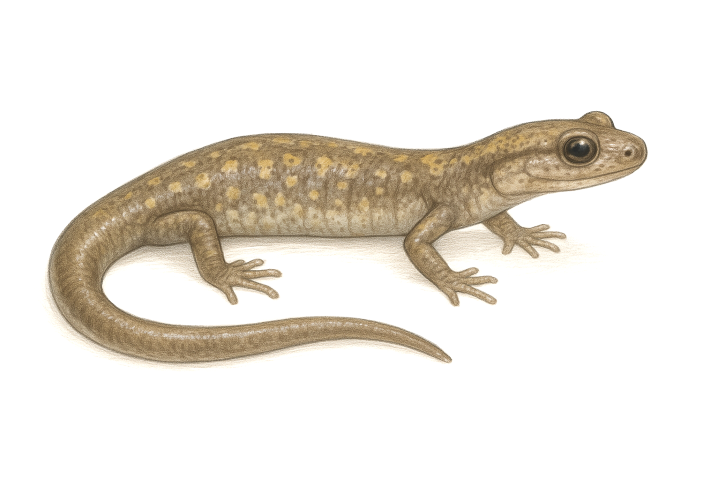
Found only on a single mountain in Georgia, the Pigeon Mountain Salamander is about as local as it gets. This slender, secretive amphibian is a true Appalachian native and one of the rarer salamanders in the U.S. What makes it fascinating? Its ultra-limited range and preference for specific rocky habitats make it a great example of how unique wildlife can be closely tied to the land.
Size & Physical Appearance
Pigeon Mountain Salamanders are small and slender, with adults typically measuring about 3.5 to 5.5 inches in total length. Their body is usually dark brown or black with an overlay of brassy or bronze-colored flecks that gives them a speckled or slightly metallic look.
The tail is about half the total body length and is slightly flattened. Juveniles tend to be darker and may have less obvious flecking. There aren’t major visual differences between males and females, at least not ones easily seen without close inspection.
Habitat and Range
This salamander has an extremely restricted range; it is endemic to Pigeon Mountain, part of the Cumberland Plateau in northwest Georgia. You won’t find it anywhere else in the world.
It lives in moist, rocky forests, especially near cliff faces, boulder fields, and outcroppings with plenty of cracks and crevices to hide in. These salamanders are mainly found at middle elevations and depend on cool, shaded conditions with high humidity.
Because their range is so limited and specialized, they are particularly sensitive to habitat disturbance, logging, and changes in moisture levels.
Diet
Pigeon Mountain Salamanders are nocturnal hunters that feed on a variety of small invertebrates. Their diet includes ants, springtails, spiders, beetles, mites, and other tiny arthropods found within leaf litter and under logs.
They’re part of the ecosystem’s cleanup crew, keeping insect populations in check and playing an important role in forest floor health.
Lifespan
In the wild, these salamanders can live for at least 10 to 15 years, possibly longer. Like many woodland salamanders, they grow slowly and tend to have long lives, especially if they manage to avoid predators and keep their skin moist.
There’s not much data on their lifespan in captivity because their specialized needs make them uncommon in captivity or the pet trade.
Identification Tips
It’s easy to confuse the Pigeon Mountain Salamander with a couple of its close cousins, especially the Southern Appalachian salamanders like the Southern Zigzag Salamander (Plethodon ventralis) or the Yonahlossee Salamander (Plethodon yonahlossee).
Here’s what sets the Pigeon Mountain Salamander apart:
- Coloration: Look for a dark background color with brassy, irregular flecks rather than a straight-lined stripe or bold blotches.
- Range: It only occurs on Pigeon Mountain. If you’re not there, it’s probably not this species.
- Size and shape: Relatively slender with a moderately long, slightly flattened tail.
If in doubt, take a photo and consult a local herpetologist or wildlife resource. These salamanders are protected, so handle them only when necessary and with extreme care.
Fun Fact
This species was actually undiscovered by science until 1979. That’s pretty recent in the grand scheme! Its discovery highlighted just how much biodiversity can be hidden in plain sight on a single mountain ridge.
Pigeon Mountain Salamanders are also a great example of endemism, meaning they exist nowhere else in the world. For wildlife fans, it’s like having a one-species-only treasure tucked away in Georgia’s forests.
If you’re lucky enough to spot one, enjoy it with your eyes and your camera — and leave it in its natural home. These salamanders are reminders of how much there still is to learn and protect in our local ecosystems.