
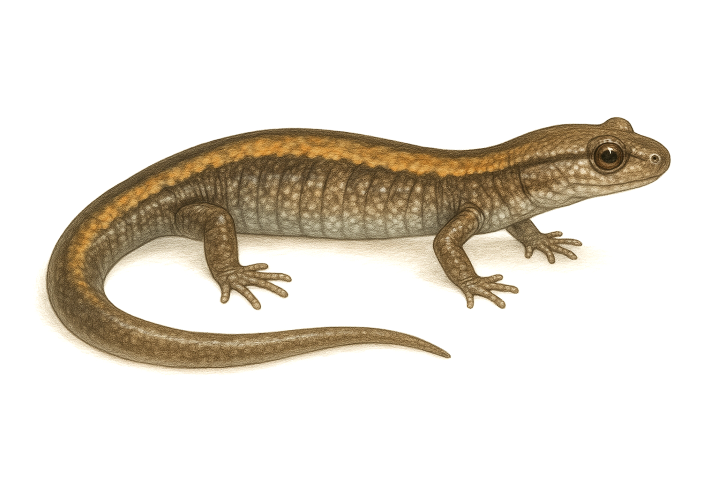
Tucked away in the misty forests of Virginia and West Virginia, the Shenandoah Mountain Salamander (Plethodon virginia) is a small, secretive amphibian that most people have never seen — and that’s part of what makes it so fascinating. It’s a lungless salamander that breathes straight through its skin, relying on cool, moist forest floors to survive. Endemic to a narrow region of the central Appalachian Mountains, this little creature is not just unique — it’s also a great example of what makes Appalachia such an important hotspot for amphibian diversity.
Size & Physical Appearance
The Shenandoah Mountain Salamander is relatively small, measuring about 2.5 to 4 inches long from snout to tail. It’s generally black or dark brown, with fine brassy or greenish flecks that give it a subtle shimmer in the right lighting. These flecks tend to be more concentrated along the back and sides.
You won’t see dramatic differences between males and females just by looking at them. Juveniles, however, may have a slightly more faded appearance until they mature.
Its slender body and smooth skin are classic traits of Plethodon salamanders — a group known for ditching the aquatic larval stage entirely and developing straight from eggs into miniature versions of the adults.
Habitat and Range
This salamander is a true Appalachian specialist. Its range is extremely limited, found only in the mountainous forests of western Virginia and adjacent eastern West Virginia, particularly along the Shenandoah Mountain ridgeline in the George Washington National Forest.
It prefers moist, mature hardwood forests and tends to hang out under rocks, logs, or within leaf litter. It’s most active at night or during wet, cool weather. You’ll typically find it at elevations between 2,300 and 4,000 feet, where the temperatures are cooler and the forest floor stays damp year round — perfect conditions for a lungless salamander that needs to keep its skin moist.
Diet
Like many of its woodland cousins, the Shenandoah Mountain Salamander feeds on small invertebrates such as:
- Springtails
- Mites
- Ants
- Small beetles
- Other tiny soil-dwelling insects
Its feeding strategy is simple but effective — it lies in wait under cover and silently ambushes prey using its sticky tongue to snatch up whatever wanders close enough. Because it’s nocturnal, it does most of its hunting at night when humidity is higher and prey is more active.
Lifespan
In the wild, estimates suggest Shenandoah Mountain Salamanders can live up to 10 to 15 years, though exact data is limited due to its secretive nature. In captivity, if properly cared for (which is quite rare and often discouraged due to its conservation status), similar species have been known to live over 15 years.
Identification Tips
This species can be tricky to distinguish from a few of its close relatives, especially the slimy salamanders (Plethodon glutinosus complex) or the Cow Knob Salamander (Plethodon punctatus), which shares some overlapping habitat.
Here’s how to tell them apart:
- Shenandoah Mountain Salamander: Small size, black to dark brown body with fine brassy or greenish flecks on the back, no distinct spots or bands
- Cow Knob Salamander: Also limited to the same region, but has bright white or yellow irregular spots or blotches rather than fine flecking
- Slimy Salamander: Typically larger, with a sticky skin secretion and more distinct white spots or blotches scattered across the body
If you’re herping (that’s the term for searching for reptiles and amphibians in the wild), location can be a huge clue. This species really is a high-elevation specialist, so keep that in mind when identifying.
Fun Fact
The Shenandoah Mountain Salamander is what scientists call an endemic species, meaning it exists nowhere else on earth besides its small home in the central Appalachians. That gives it a sort of local celebrity status among herpetologists and nature watchers. It’s also a symbol of how unique and fragile mountain ecosystems can be — especially when they host creatures with such a tiny range.
Final Thoughts
If you ever find yourself hiking the quiet ridges of the George Washington National Forest on a damp, overcast day, slow down and look under a few logs or leaf piles (just be gentle and always replace them). You may just spot the elusive Shenandoah Mountain Salamander — a small but special piece of Appalachia’s rich natural heritage. Watching one scurry back into the leaf litter is a good reminder of how much life thrives just beneath our feet.