
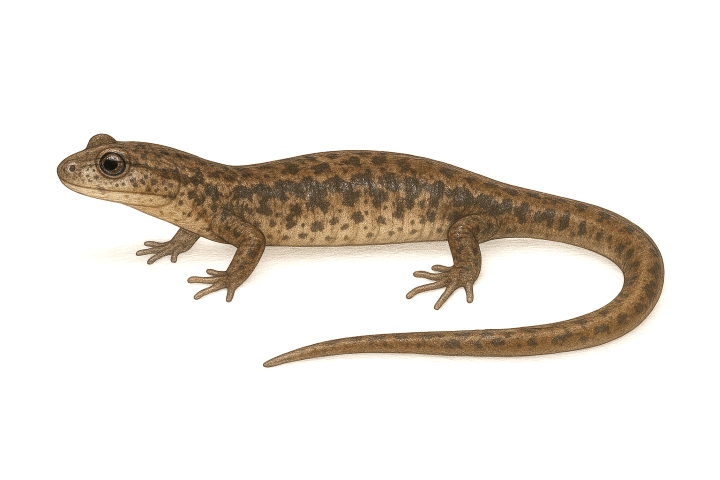
The Caddo Mountain Salamander is a hidden gem of the Arkansas highlands. Found only in a small slice of the world, this secretive lungless salamander is perfectly suited for life in the cool, moist crevices of the Ouachita Mountains. It’s a classic example of an amphibian that’s easy to miss — but once you spot one, you won’t forget it.
Size & Physical Appearance
Caddo Mountain Salamanders are on the smaller side, typically measuring between 2.5 and 4 inches (6 to 10 cm) from snout to tail. Their body is slender with a rounded head and relatively short limbs.
One of their most distinctive features is their coloring. Most individuals are dark gray to black with a scattered pattern of whitish or brassy flecks along the back and sides. These light spots can vary in density — some salamanders look heavily speckled, while others might look dark with just a few dots.
Unlike some other amphibians, there aren’t obvious differences between males and females just by looking. Juveniles look similar to adults but may be slightly paler and more translucent.
Habitat and Range
This salamander has an extremely limited range. It’s found only in the Caddo Mountains — a portion of the larger Ouachita Mountains in western Arkansas. That makes it an endemic species, meaning it lives nowhere else on Earth.
Caddo Mountain Salamanders love cool, moist forested areas, especially those with loose rock or talus slopes where they can hide and stay out of the heat. They tend to be found at higher elevations, usually above 600 feet (roughly 180 meters).
During wet conditions, especially in spring and fall, they may come out above ground. But for most of the year, they’re tucked away in moist underground shelters to beat the summer heat and winter chill.
Diet
Like other small woodland salamanders, the Caddo Mountain Salamander feeds on tiny invertebrates it finds in the leaf litter or soil. That includes ants, mites, springtails, beetle larvae, and small spiders.
They’re ambush predators, sitting and waiting for movement before striking. It’s a small but important role in keeping the forest floor’s micro-ecosystem in balance.
Lifespan
In the wild, these salamanders are believed to live anywhere from 5 to 10 years, though exact data is limited due to their secretive lifestyle. In captivity, closely related species have been known to live upward of 10 years, but this species isn’t commonly kept, and we don’t have much hard data.
Identification Tips
Trying to tell a Caddo Mountain Salamander from other salamanders? Here’s what to look for:
- Brassy or whitish flecks on a dark background — not stripes or bold patterns
- Slender body with no obvious costal grooves (the lines along the ribs seen in some species)
- No external gills or webbed feet — this is a lungless salamander that breathes through its skin
- Compare to the Rich Mountain Salamander (Plethodon ouachitae), which has a similar range but more reddish coloring and is found just to the west
Your best chance for correct identification usually comes down to location. Since this species is only found in a specific region of the Ouachitas, range matters.
Fun Fact
Here’s something cool: The Caddo Mountain Salamander doesn’t have lungs — it breathes entirely through its skin and the lining of its mouth! Because of this, it has to stay moist to survive and is extremely sensitive to changes in humidity and temperature. That’s part of why they’re limited to such specific, cool habitats.
In Summary
The Caddo Mountain Salamander is a great example of how specialized and fragile amphibian species can be. It survives in small, shady patches of the Arkansas highlands, too often overlooked by hikers and nature-goers. But understanding and protecting salamanders like this one is important — they’re indicators of forest health and help keep insect populations in check.
If you’re hiking in the Ouachitas, take a closer look at the forest floor and rocky stream edges — just be sure to tread carefully. And remember, their home is one-of-a-kind, just like them.