
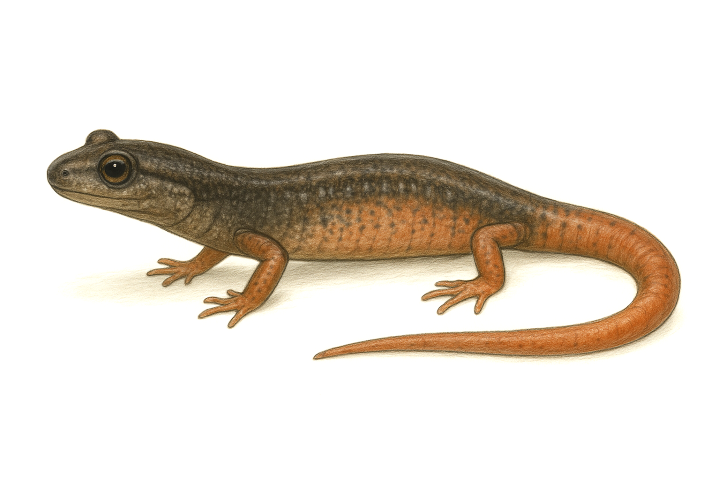
The Red-legged Salamander (Plethodon shermani) might not be the most famous amphibian out there, but it’s definitely one of the more striking ones. As the name suggests, it’s best known for its boldly colored red or reddish-orange legs, which give it a flashy contrast against its otherwise dark body. It’s also a member of the lungless salamander family, which means it breathes entirely through its skin and the lining of its mouth — a pretty neat adaptation for life in the leaf litter of cool mountain forests.
Size & Physical Appearance
Adult Red-legged Salamanders typically range from 4 to 6 inches in length, including their tail. They have a slender body with a broad head and smooth skin. Their base color is usually a dark slate gray to black, and the real showstopper is their legs — vividly red or reddish-orange, often with flecks extending slightly into the lower sides.
There’s also often a dusky “salt and pepper” sprinkling across the back thanks to small white or silvery specks. Juveniles and adults look quite similar, although younger individuals might have slightly duller colors. Males can sometimes be identified by a more swollen cloacal area during the breeding season, but otherwise, there’s not much visual difference between sexes.
Habitat and Range
This salamander is a true Appalachian native. It’s found at higher elevations — typically above 2,500 feet — in the southern Appalachian Mountains of North Carolina, Tennessee, and Georgia, with a small presence in parts of South Carolina as well. They prefer cool, moist, forested habitats like oak or mixed mesophytic (moist) forests.
You’ll usually find them hiding under rocks, rotting logs, or deep leaf litter. Because they’re lungless, they need to stay damp to breathe, so they’re most active in the early morning, evening, or after rain.
Diet
Red-legged Salamanders are carnivorous and feed mostly on small invertebrates. Their menu includes:
- Springtails
- Ants
- Beetles
- Spiders
- Small snails and worms
They’re patient predators, slowly stalking their prey through the leaf litter or waiting in ambush under cover.
Lifespan
In the wild, Red-legged Salamanders can live for up to 10 to 15 years, though precise data is limited. In captivity, with proper care, some individuals in the Plethodon family have lived beyond 15 years. Their secretive nature and slow metabolism help them live relatively long lives for their size.
Identification Tips
The Red-legged Salamander can be confused with a few other species, especially other Plethodon salamanders:
- Blue Ridge Two-lined Salamanders: These are smaller, more slender, and have yellow bodies with two dark lines running down their backs — and no red legs.
- Southern Red-backed Salamanders: Look for a rust-colored stripe down the back; their legs are not nearly as vibrant as those of the Red-legged Salamander.
- Ocoee Salamander: Found in overlapping ranges, but they usually have a more mottled pattern and lack the bold red on the legs.
The biggest giveaway? If you spot those brilliant red legs on a dark-bodied salamander in the southern Appalachians, odds are, you’ve found a Red-legged Salamander.
Fun Fact
Despite being a land-dweller, the Red-legged Salamander lays its eggs underground and completely skips the aquatic larval stage. That’s right — baby salamanders hatch out as fully-formed miniature adults, never setting foot in water!
Final Thoughts
The Red-legged Salamander is a hidden gem of the mountain forests — beautiful, quiet, and essential to the ecosystem. If you’re hiking in the southern Appalachians and turning over rocks or logs (carefully, of course), keep your eyes peeled and your camera ready. Just be sure to gently return anything you move — these little guys depend on those damp spaces to survive.
Want to help salamanders like this one? Preserve their forest homes, keep streams clean, and never collect wild amphibians. They’re happiest and healthiest right where they belong — in the wild.