
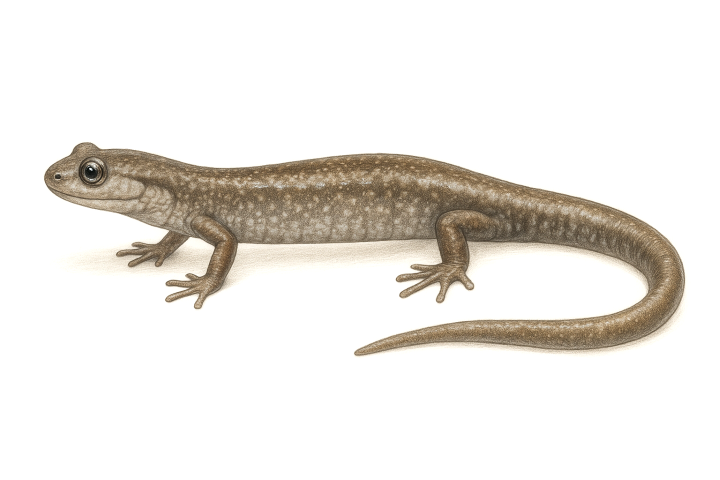
If you’re hiking through the shaded forests of western North Carolina, keep your eyes peeled near the moist forest floor—you might just spot the South Mountain Gray-cheeked Salamander. This little amphibian isn’t flashy, but it’s a special find. Endemic to just a small section of the southern Appalachian Mountains, it’s a true local that you’re not going to see just anywhere. Its limited range and quiet habits make it a bit of a hidden gem in the salamander world.
Size & Physical Appearance
The South Mountain Gray-cheeked Salamander is a petite creature. Adults usually measure between 3 to 5 inches (7.5 to 13 cm) in total length. Their bodies are slender, and their coloration is subtle but elegant.
Their overall color is typically dark brown to black, sometimes with a faint bluish or purplish hue in the right light. The key feature that gives them their name is the pale gray shading on the sides of their head, which can look like “cheeks.” It’s a detail that can be easy to miss unless you’re looking closely.
Juveniles often appear a little more uniform in color and may lack fully developed gray cheek markings. Males and females look quite similar, at least to the untrained eye, though males may have slightly more prominent mental glands (used during courtship) during breeding season.
Habitat and Range
This salamander has a very small range. It’s found only in the South Mountains of western North Carolina, which makes it an endemic species—meaning it lives nowhere else on Earth.
Preferred habitat includes cool, moist deciduous forests, especially in areas with lots of leaf litter, rotting logs, and rocky crevices. They’re most commonly spotted at mid to high elevations, around 1,000 to 2,800 feet (300 to 850 meters).
Because they don’t have lungs (like all members of the Plethodon genus), they breathe through their skin, which means they require constant moisture in their environment.
Diet
The South Mountain Gray-cheeked Salamander is a nighttime hunter. It feeds on a variety of small invertebrates including:
- Springtails
- Mites
- Spiders
- Ants and other small insects
Their diet isn’t particularly exotic, but what’s interesting is how essential they are to controlling populations of tiny forest floor critters. They’re part of the unseen army that keeps forest ecosystems healthy and balanced.
Lifespan
In the wild, these salamanders may live for up to 10 years or more, although exact numbers are hard to pin down due to their elusive nature. In captivity, similar Plethodon species have been known to live over a decade with consistent care.
Identification Tips
This salamander can be confused with other members of the Plethodon genus, especially the Gray-cheeked Salamander (Plethodon montanus), which it closely resembles.
Here are a few ways to tell them apart:
- Range matters: If you’re in the South Mountains of North Carolina, you’re probably looking at P. meridianus. They don’t overlap much with related species.
- Size and shade: P. meridianus tends to be a bit darker overall, and the gray cheek patches are often more pronounced than those on P. montanus.
- Lack of stripes: Unlike some other native salamanders (like slimy salamanders or red-backed salamanders), this one doesn’t have bold stripes or spots.
If you’re unsure, location and subtle color cues are your best bet.
Fun Fact
The South Mountain Gray-cheeked Salamander has a fascinating history—it was actually considered a subspecies of another salamander until 2000, when scientists determined that its genetics and unique range made it distinct enough to be its own species. That means it’s a pretty recent addition to the list of recognized U.S. amphibians—not new to nature, just to science!
Why It Matters
Because this species has such a limited range, it’s considered vulnerable to habitat disturbance. Logging, development, or changes in climate that affect the forest moisture could put them at risk.
If you’re exploring their home turf, be mindful of where you step and avoid moving logs or rocks where these creatures live. Observing them is a treat, but keeping their habitat undisturbed helps ensure future generations can enjoy them too.
In Summary
The South Mountain Gray-cheeked Salamander might not be the flashiest amphibian, but its limited range, quiet beauty, and ecological role make it a species worth appreciating. If you’re out in the southern Appalachian foothills, take a moment to look under a damp log or take in the quiet richness of the forest floor—you might just catch a glimpse of a rare local that few people ever see.