
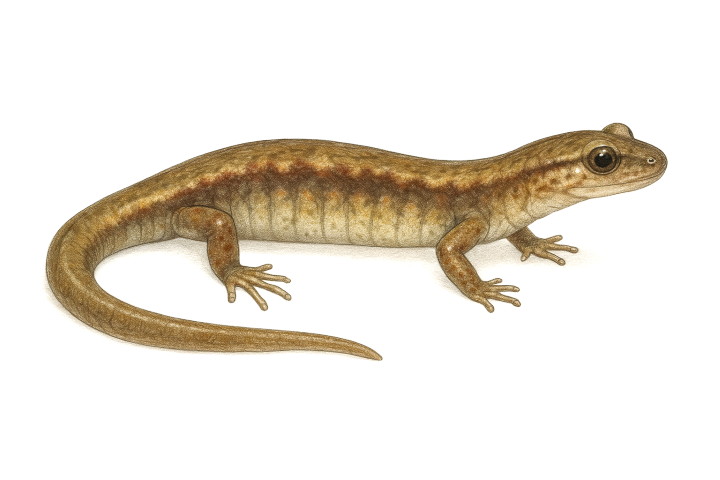
The Big Levels Salamander (Plethodon sherando) is a rare little amphibian known only from a small patch of forest in Virginia. With its bold spotting and secretive habits, this salamander is a real hidden gem of the Appalachian Mountains. First described in 2004, it was once thought to be a variant of a similar species, but scientists eventually realized it was something entirely unique. If you’re interested in lesser-known wildlife, this is one cool critter to know about.
Size & Physical Appearance
Big Levels Salamanders are small to medium-sized, usually measuring about 2.5 to 4 inches in total length. They have a dark black to slate-gray body with scattered white or pale yellowish spots, most visible on the sides and limbs. Their bellies tend to be grayish and mottled.
Young salamanders often look like miniature adults but may have fewer spots or a duller color early on. Males and females are difficult to tell apart just by looking—there’s no extreme size difference or bright coloring between the sexes like you might see in some other amphibians.
Habitat and Range
The Big Levels Salamander has an extremely limited range. It’s found only in the Big Levels area of the Blue Ridge Mountains in Augusta County, Virginia. That’s a tiny slice of land, less than about 20 square miles total.
This salamander lives in cool, moist hardwood forests at elevations between 2,100 and 3,800 feet. It likes north- or east-facing slopes with plenty of rock outcrops and leaf litter—places that stay damp and shaded, even in the heat of summer. Since it lacks lungs and breathes through its skin (like all members of the Plethodon genus), moisture is essential for survival.
Diet
Like many woodland salamanders, Big Levels Salamanders are insectivores. They mostly feed on tiny invertebrates they find crawling among the leaves or under rocks—think mites, ants, beetles, spiders, and springtails.
They’re opportunistic hunters, prowling at night or during damp weather when prey is active. What’s impressive is how efficient they are for their size, playing an important role in the forest ecosystem by helping control small insect populations.
Lifespan
In the wild, Big Levels Salamanders can live up to 10 to 15 years, though exact data is hard to come by due to their limited range and secretive nature. If kept in captivity (typically for scientific research), they may live just as long with the right care.
Identification Tips
One of the main identification challenges is telling the Big Levels Salamander apart from the Eastern Red-backed Salamander (Plethodon cinereus) or the Shenandoah Mountain Salamander (Plethodon virginia), which it closely resembles.
Here’s how to spot the difference:
- No red stripe: Big Levels Salamanders don’t have the characteristic red or orange dorsal stripe seen on Red-backed Salamanders.
- Larger white spotting: Compared to the Shenandoah Mountain Salamander, the Big Levels has larger and more distinct side spots.
- Location is key: If you’re in the Big Levels area of Virginia and find a dark salamander with white side spots and no back stripe, you’ve likely found the right species.
Still, IDing salamanders in this group can be tough without a trained eye or lab work, so don’t sweat it too much. When in doubt, take a photo and compare it to reliable sources or reach out to local herpetologists.
Fun Fact
The Big Levels Salamander is one of just a few amphibian species entirely restricted to a single mountain range in the eastern U.S. In fact, it was only discovered in 2001, and named a new species in 2004—making it one of the newest salamander species known from the U.S. That’s right—scientists are still finding new amphibians right here in America!
In Summary
The Big Levels Salamander may be small and secretive, but it’s a fascinating and rare part of Appalachia’s biodiversity. Its tiny range, quiet habits, and striking appearance make it a cool species to learn about—and an important reminder of how much nature can still surprise us, even in well-studied regions.
If you’re exploring trails in the Big Levels area in western Virginia, keep your eyes peeled on cool, shaded slopes—but remember, take only photos and leave rocks and logs where you found them. These salamanders rely on that habitat to survive.
More Amphibians to Explore
Check out the Shenandoah Mountain Salamander or the Slimy Salamanders for more members of the same quirky family!