
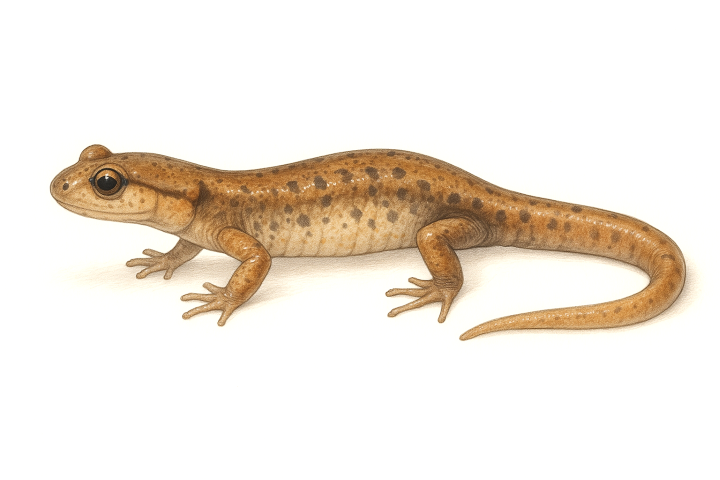
If you’re hiking through a quiet forest in the western United States and spot a small, brightly colored salamander under a log or leaf litter, you might have found an Ensatina. This little amphibian is famous among scientists for its coloring and complex variations — so much so, it’s often used as a textbook example of evolution in action. Curious, secretive, and often overlooked, the Ensatina is a fascinating resident of the forest floor.
Size & Physical Appearance
Ensatinas are small to medium-sized salamanders, usually measuring between 3 to 5 inches long from snout to tail. They look slim and delicate, with moist, smooth skin and a rounded head.
One of the most striking things about Ensatinas is how much their appearance can change depending on where they live. They come in several color patterns, from orange-limbed with dark brown backs (like the famous Monterey Ensatina) to bright yellow, olive-green, or even solid black varieties. Some have dark blotches or spots, while others are more evenly colored.
Males and females look very similar, though males may have a slightly more prominent tail base. Juveniles usually appear paler and more translucent before developing adult coloration.
Habitat and Range
Ensatinas have a pretty specific set of real estate requirements. They live mostly in moist woodlands, oak forests, conifer forests, and shaded canyons. You can find them from sea level up to around 11,000 feet in elevation in some mountainous areas.
These salamanders are native to the western United States and parts of northern Mexico. They’re especially common along the Pacific Coast — spotted in California, Oregon, and Washington. They need damp conditions to thrive, so you’re most likely to find them under logs, rocks, or leaf litter, especially during the wet seasons.
Diet
Ensatinas are carnivorous and have a taste for tiny creatures. Their diet includes:
- Small insects
- Spiders
- Ants
- Beetles
- Worms
- Other small invertebrates
They use their sticky tongue to catch prey, sort of like a frog. It’s fast and surprisingly accurate.
Lifespan
In the wild, Ensatinas can live up to 15 years under the right conditions, though many live shorter lives due to predators or environmental stress. In captivity, with steady moisture and temperature, they may live even a bit longer, but they’re not commonly kept as pets due to their specific habitat needs.
Identification Tips
Because Ensatinas come in so many different colors, they can easily be confused with other salamanders like the Western Red-backed Salamander or juvenile California Newts.
Here are a few ways to tell an Ensatina apart:
- Constriction at the base of the tail — This is unique to Ensatinas and makes them look like the tail is pinched in near the body.
- Relatively long legs and toes — Useful for climbing and maneuvering through leaf litter.
- Smooth skin — Unlike newts, which often have rougher or granular textures.
- Moist conditions — They’re rarely found far from a damp environment, so context can help.
If you’re near the Pacific Northwest or coastal California and spot a small salamander with a narrow tail base and moist skin, there’s a good chance you’re looking at an Ensatina.
Fun Fact
One of the coolest things about Ensatinas? They’re a real-life example of something called a ring species. Around California’s Central Valley, different populations of Ensatina have evolved to look and act slightly differently depending on geography. At the north end of the “ring,” neighboring groups can mate with each other. But by the time populations reach the southern end, they’re so different they can’t reproduce with one another — despite all being the same species on paper.
Scientists love using Ensatinas to demonstrate how species can evolve gradually over space and time.
Wrapping Up
The Ensatina is more than just a pretty salamander — it’s a marvel of adaptation, subtle variation, and evolutionary storytelling. If you’re adventuring on a rainy hike in western forests and happen to flip over a log, tread gently. You might be lucky enough to meet one of nature’s most mysterious shape-shifters.
Just remember to gently replace any cover objects you move so these little salamanders can stay safe and moist.