
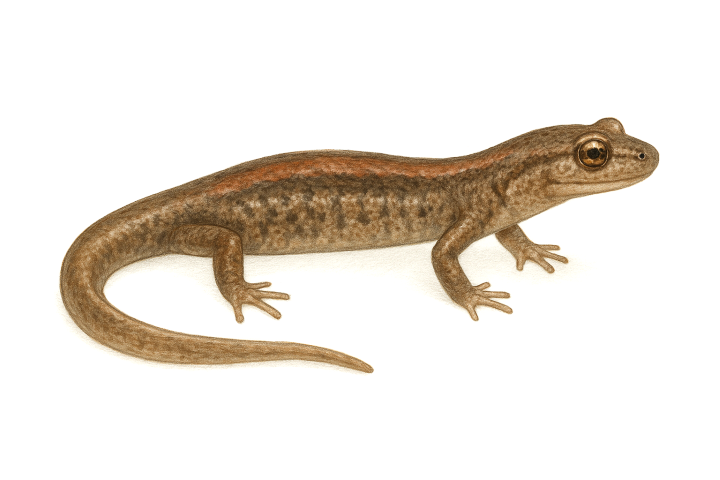
The Imitator Salamander is a small, secretive amphibian with a big name and an even bigger trick up its sleeve. As the name suggests, this salamander is known for mimicking the appearance of another species — but more on that in a bit. Found only in a small region of the southern Appalachian Mountains, it’s a fascinating little resident of misty forests and cool mountain creeks.
Size & Physical Appearance
Adult Imitator Salamanders typically measure between 2.5 to 4 inches in total length. They have slender bodies with moderately long tails and delicate limbs.
Their color varies from dark brown to gray or black, often with light bluish or greenish flecks along the back and sides. Some individuals have a faint dorsal stripe, though it’s not always easy to spot.
The underside tends to be lighter, often pale gray with some speckling. Males tend to have slightly broader heads than females, especially noticeable during the breeding season. Juveniles look similar to adults but are smaller and often have brighter coloration.
Habitat and Range
This salamander is a true mountain dweller. It lives in the southern Appalachian Mountains, specifically in parts of eastern Tennessee and western North Carolina. It’s primarily found in the Great Smoky Mountains National Park and surrounding high-elevation areas.
Imitator Salamanders prefer cool, moist hardwood forests, especially near streams, seeps, or rocky outcrops. Elevation matters for this species — they are found mostly at high elevations above 3,000 feet, often in shaded, mossy environments where the air stays damp and cool.
Diet
Like many small woodland salamanders, Imitator Salamanders are opportunistic feeders. They eat a variety of tiny invertebrates, such as:
- Small insects
- Springtails
- Spiders
- Worms and mites
They hunt mostly at night, using their keen sense of smell and sight to find food on the forest floor or under leaf litter and logs. While their diet might not sound thrilling, it’s a crucial part of the forest ecosystem.
Lifespan
In the wild, Imitator Salamanders likely live around 5 to 10 years, though exact data is hard to come by due to their secretive nature. In captivity, with the right care, they may live a bit longer, but this species isn’t commonly kept as a pet or studied in captivity.
Identification Tips
This salamander gets its name because it does a pretty good job mimicking the larger Red-cheeked Salamander (Plethodon jordani), which shares its high-elevation habitat.
Here’s how to tell them apart:
- Size: Imitator Salamanders are smaller than Red-cheeked Salamanders.
- Cheek color: Red-cheeked Salamanders have distinctive bright red patches behind the eyes. Imitators usually lack the bright red cheeks, or only have a dull version of it.
- Tail: The Imitator’s tail is slightly laterally compressed (flattened side-to-side), which is typical of species in the genus Desmognathus.
- Habitat habits: Red-cheeked Salamanders are fully terrestrial, while Imitators may be spotted closer to seepage areas or damp rock faces.
The mimicry is thought to be defensive — by resembling the chemically protected Red-cheeked Salamander, the Imitator might avoid predators who’ve learned to stay away from its look-alike.
Fun Fact
Here’s the wild thing: The Imitator Salamander actually shares its range almost exactly with its model, the Red-cheeked Salamander — a phenomenon biologists call Batesian mimicry. It’s one of the few known examples of a salamander imitating another species in the wild!
In Summary
The Imitator Salamander might be small, but its survival strategy is mighty clever. Found only in a narrow slice of the southern Appalachians, it’s a great example of how species adapt to their environment — both in color and behavior. If you’re hiking in the Smokies and flip over a rock in a cool, damp forest, you just might spot one of these elusive amphibians. Just be sure to return the rock gently — these salamanders, like their fragile homes, are worth taking care of.