
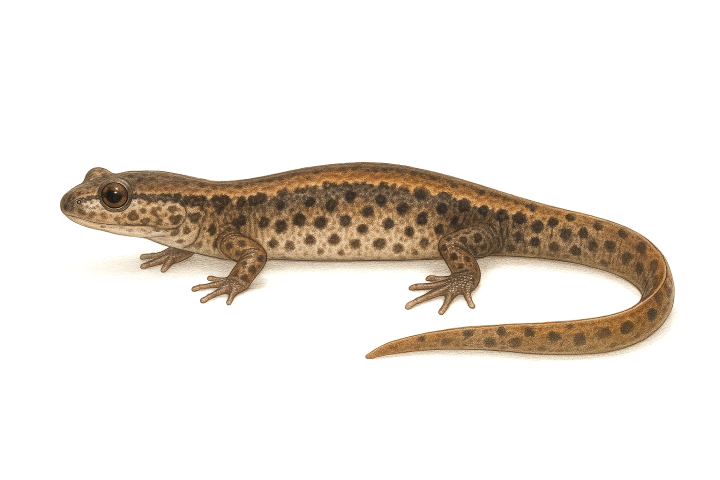
The Spotted Dusky Salamander is a small, secretive amphibian that spends most of its life tucked away under rocks, logs, or forest debris near clean, running water. It might not be flashy, but if you’re out exploring Appalachian creeks or southern woods and flip over a damp rock, you just might find one peeking back at you. What sets it apart? That subtle pattern of light spots on its back and sides—and its love for cool, mossy seeps and trickling streams.
Size & Physical Appearance
Adult Spotted Dusky Salamanders usually grow to about 2.5 to 5 inches long, including their tail. They’re slender-bodied with a somewhat flattened appearance, and they vary quite a bit in pattern and color.
Their base color ranges from gray-brown to reddish-brown, with rows of small pale spots along the sides and back. These spots can sometimes be faint or more pronounced, depending on the individual and where it lives. Some also have a subtle light line from the eye to the jaw.
Males tend to have slightly longer and thicker tails compared to females, and during the breeding season, they may develop small mental glands on the chin. Juveniles often look like smaller versions of adults, but the spotting may be more vivid.
Habitat and Range
Spotted Dusky Salamanders are mostly found in the southeastern United States. Their range includes states like Missouri, Arkansas, Louisiana, Mississippi, Alabama, Georgia, Tennessee, Kentucky, North Carolina, and parts of Texas and Oklahoma. They tend to avoid the coast and are more common in hilly or mountainous terrain.
They love moist, shady areas near clean running water—think spring-fed creeks, seeps, or mountain streams. You’ll find them hanging out under rocks, mossy logs, or leaf litter, especially in hardwood forests. Unlike some salamanders, they’re pretty tied to water sources and don’t usually venture far.
You’ll often find them from low elevations to moderate Appalachian hillsides. They’re good climbers across moss and damp rocks but aren’t really tree dwellers.
Diet
Spotted Dusky Salamanders are carnivores and aren’t picky eaters. Their diet includes:
- Small insects
- Spiders
- Worms
- Crustaceans
- Other small invertebrates
They’re sit-and-wait predators, meaning they tend to stay still and nab prey that wanders too close. Occasionally, they may even eat smaller salamanders—yes, even of their own species if resources are tight.
Lifespan
In the wild, their average lifespan is around 10 to 15 years, though reliable data is limited. In captivity, they may live longer if well cared for, though they’re not commonly kept as pets due to their specific habitat needs.
Identification Tips
Spotted Dusky Salamanders can be tricky to ID, especially since they look similar to other members of the Desmognathus genus. Here’s how to tell them apart:
- Look for pale spotting: Unlike the Plain Dusky Salamander (Desmognathus fuscus), Spotteds usually have small, irregular pale spots along their back and sides.
- Tail shape matters: Their tail is usually keeled (flattened on the sides into a ridge), and in adults, it tends to be more knife-edged than in some related species.
- Range overlaps with others: In areas where multiple dusky salamander species occur, looking at tail shape, body markings, and head shape can help—but it’s not always easy. In tricky spots, experts may rely on genetics or detailed morphometrics.
They’re most likely to be confused with the Southern Dusky Salamander (Desmognathus auriculatus), but that species usually lacks spotting and prefers swamp-like environments, not cool, running streams.
Fun Fact
Believe it or not, Spotted Dusky Salamanders don’t have lungs. They breathe entirely through their skin and the lining of their mouth, which is why it’s so important for them to stay moist. That also means they’re super sensitive to pollution or changes in their stream habitat—if they disappear, it could be a sign the water quality has taken a dive.
Whether you’re turning over rocks in the Ozarks or hiking along a shady Appalachian stream, keep an eye out for this quiet little amphibian. The Spotted Dusky Salamander might not be loud or flashy, but it’s an important part of its ecosystem—and fascinating once you get to know it.