
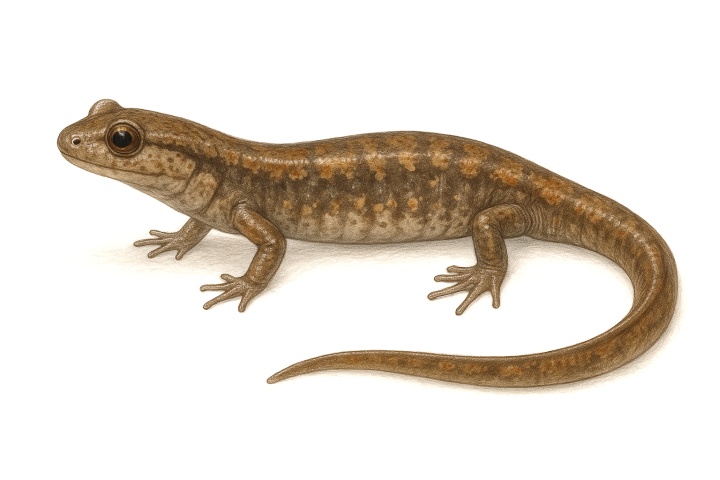
The Ouachita Dusky Salamander (Desmognathus brimleyorum) may not be a household name, but it’s a fascinating little amphibian that’s full of surprises. Native to the misty hills and cool streams of the southern U.S., it’s part of a larger group called the dusky salamanders — but it has some unique features that set it apart. If you’re into nature walks or creek explorations in Arkansas or nearby, there’s a good chance you’ve already met one and just didn’t realize it.
Size & Physical Appearance
This salamander stays on the petite side. Adults typically measure 2.5 to 5 inches in length from snout to tail. The body is slender, and the tail is usually about half the total length.
Color-wise, they’re earthy and variable. Most individuals are chocolate brown to gray-brown, with lighter markings along the back. You might notice a faint, wavy dorsal stripe or rows of light spots along the sides — they’re not flashy, but they blend in beautifully with the leaf litter and moss near their streams.
Males and females look pretty similar, though males may have slightly broader heads. Juveniles often show more contrast in their markings, including lighter tails that darken as they age.
Habitat and Range
This species is strongly tied to water, but not just any water. The Ouachita Dusky Salamander loves cold, well-oxygenated streams, clear springs, rocky seeps, and wet forested ravines. You’ll usually find them under rocks, logs, and leaf litter near these stream banks — the wetter and cooler, the better.
Geographically, they’re only found in a fairly narrow area of the southern U.S., mainly in the Ouachita Mountains of Arkansas and southeastern Oklahoma. Their elevation range is pretty wide, from lowland creeks up to higher montane streams.
Diet
Like most small salamanders, the Ouachita Dusky is an opportunistic predator. It usually hunts small invertebrates such as:
- Insects (like flies, beetles, ants)
- Spiders
- Worms
- Snails and other soft-bodied critters
It hunts mostly at night and uses a sit-and-wait strategy, often relying on its quick tongue to grab unsuspecting prey. In the cool, moist forest floors where it lives, food is abundant — and so is competition, which keeps its hunting skills sharp.
Lifespan
In the wild, Ouachita Duskies can live around 8 to 10 years, though precise numbers can vary. In captivity, where threats are minimal and food is consistent, they might live a little longer, but most data on their captive lifespan is limited since they aren’t commonly kept.
Identification Tips
Here’s where it gets interesting — many dusky salamanders look alike. If you’re trying to tell the Ouachita Dusky Salamander apart from its close cousins (like the Northern Dusky or the Spotted Dusky), pay attention to these clues:
- Tail shape: This species has a moderately keeled tail — it’s slightly compressed from side to side rather than fully round.
- Pattern: Look for a series of slightly darker blotches or faint light speckles along the body. The pattern is usually subtle but present.
- Location: Maybe the most helpful clue — if you’re in the Ouachita Mountains or southeastern Oklahoma, and you find a dusky near a clear stream, there’s a good chance it’s D. brimleyorum.
Always remember these guys are part of a complex genus with lots of overlap. If you’re ever unsure, taking a good photo and comparing it to regional field guides is a solid move.
Fun Fact
This salamander is a bit of a homebody — in fact, it’s one of the few salamanders with a truly restricted range. It’s only found in the Ouachita region, and nowhere else on Earth! That makes it an endemic species, which makes local conservation efforts especially important for keeping this unique amphibian around.
Wrap-Up
The Ouachita Dusky Salamander may not seek the spotlight, but it plays an important role in forest ecosystems — keeping insect populations balanced and serving as a prey item for other wildlife. It’s one of the many tiny creatures that thrive in healthy streams and forests, and spotting one can be a little reminder of how wild and wonderful even the smallest corners of nature can be.
If you’re lucky enough to be exploring the lush woodlands of Arkansas or Oklahoma, keep an eye peeled near those trickling streambanks. Just be gentle — like all amphibians, these salamanders are sensitive to handling and environmental changes.
Looking to ID more dusky salamanders or amphibians in your region? Check out our other species profiles for more tips and comparisons!