
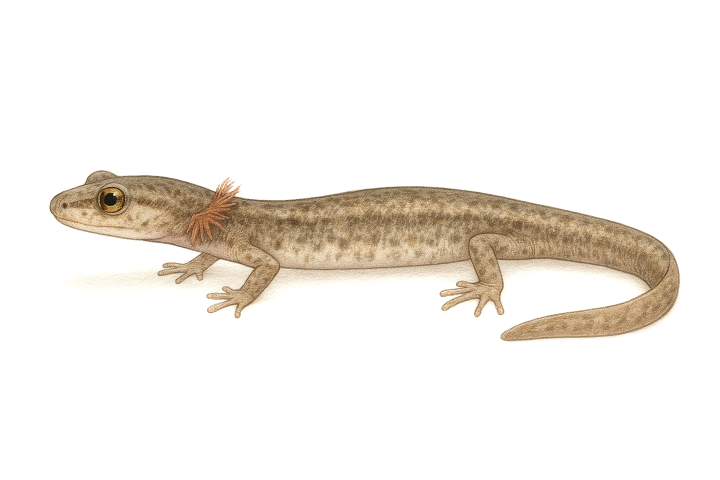
The Cascade Caverns Salamander is a secretive little amphibian that lives almost entirely underground. You won’t spot it on a casual nature walk — this salamander is so specialized to life in caves that it’s only been found in a single location in Texas. With its ghostly appearance and mysterious lifestyle, it’s one of the most unusual salamanders in the country.
Size & Physical Appearance
This salamander is on the small side, usually measuring about 1.5 to 2.5 inches long. Like many cave-dwelling animals, it has a translucent, pale pink or whitish body, which makes it look a bit like a tiny ghost. You can sometimes see its internal organs through its skin.
It also has external gills that stick out like tiny red feathers behind its head — a sure sign that it spends its life in water. Because it lives in total darkness, it has extremely reduced eyes and no eyelids. In some individuals, the eyes are barely visible at all.
Habitat and Range
The Cascade Caverns Salamander has one of the most limited ranges of any amphibian in the U.S. It’s only known from Cascade Caverns in Kendall County, Texas. That’s just a single cave system — making this species incredibly rare and highly specialized.
It lives in cold, clear groundwater inside the cave. The salamander almost never ventures above ground. It’s adapted to life in total darkness, where it hides among rocks and submerged crevices.
Diet
Because it lives underground, we don’t know everything about what the Cascade Caverns Salamander eats. But like many aquatic salamanders, its diet likely includes small aquatic invertebrates — things like amphipods, isopods, and insect larvae.
In a limited environment like a cave, food can be scarce, so these salamanders have to be opportunistic. They’ll eat whatever they can catch that’s small enough to fit in their mouths.
Lifespan
There’s still a lot to learn about this species, including how long it lives. Similar species in the genus Eurycea can live 8 to 10 years in the wild, sometimes longer in captivity. Since this salamander is rarely seen and protected, reliable lifespan data is hard to find.
Identification Tips
The Cascade Caverns Salamander is easily confused with other cave-dwelling Eurycea species like the Texas Blind Salamander (Eurycea rathbuni) and the Comal Blind Salamander (Eurycea tridentifera). They’re all small, pale, aquatic, and eyeless, and they all live in central Texas.
To tell them apart, you’d have to rely on location more than appearance. The Cascade Caverns Salamander is only found in one spot — Cascade Caverns. It’s also slightly smaller than some of its relatives, with shorter limbs and a narrower head. But these differences are subtle and usually require expert examination. For most people, the species is best identified by its limited habitat.
Fun Fact
The Cascade Caverns Salamander may have never left the dark in its entire life. Since it’s fully aquatic and cave-adapted, it’s one of just a few North American amphibians that spend their entire existence in underground water. Scientists think it may have evolved for thousands — possibly millions — of years in isolation, completely cut off from the surface world.
It’s a living reminder of how mysterious and specialized life can be — even in our own backyards.