
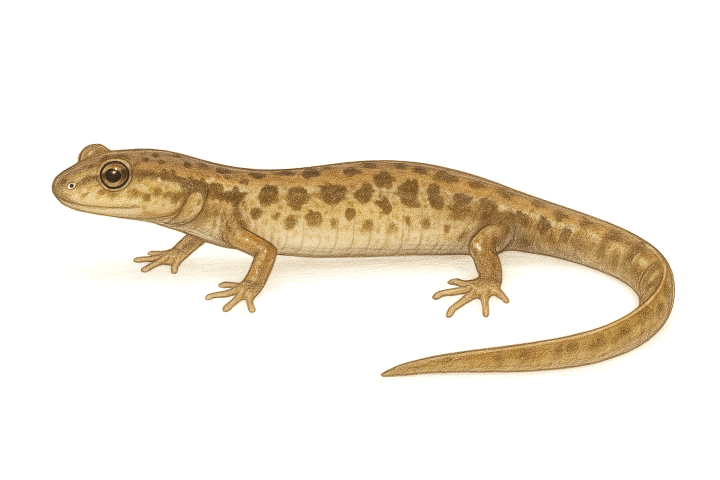
The Fern Bank Salamander is one of those hidden woodland gems you might never spot unless you know where to look. Native to central Texas and known for its strong ties to spring-fed streams, this small but striking salamander is part of the lungless salamander family. That means it breathes entirely through its skin and the lining of its mouth — how cool is that?
Despite its fairly limited range, the Fern Bank Salamander has managed to remain something of a mystery to even seasoned herpetologists. But what we do know makes it a fascinating little creature, especially if you’re into Texas wildlife or stream-dwelling amphibians.
Size & Physical Appearance
Fern Bank Salamanders are small and slender, typically growing to about 2 to 3 inches in total length. They’ve got a soft, almost translucent look that helps them blend right in with their mossy, watery habitats.
Their coloring ranges from yellowish to brownish-gray, usually with dark spots or blotches along the back. These markings sometimes form a loose pattern but can vary quite a bit from one individual to the next. Their tails are long and laterally compressed — they use them like paddles to move through water.
Juveniles resemble adults but tend to be a bit duller in color until they mature. There’s no easy way to tell males from females just by looking at them, especially outside the breeding season.
Habitat and Range
This salamander has a pretty narrow range, found only in the Edwards Plateau region of central Texas. It’s named after Fern Bank Springs, one of its known habitats. These salamanders depend heavily on clear, cool, spring-fed streams and seepage areas, usually in shaded, forested spots with a lot of ground cover like leaf litter, rocks, and, of course, ferns.
They generally stick to low to moderate elevations and prefer areas with plenty of moisture. Their habitat is fragile and very specific, which makes them vulnerable to changes in water quality or land use.
Diet
Like many small salamanders, the Fern Bank Salamander is an opportunistic feeder. It dines mostly on tiny invertebrates like springtails, mites, ants, beetle larvae, and small flies. They hunt mostly at night or during moist conditions when their slippery prey is on the move.
What makes their diet especially interesting is that because they live in such clean water systems, their food is tied closely to the health of the stream. Fewer bugs in the water can affect the whole salamander population — yet another reason why these ecosystems are worth protecting.
Lifespan
In the wild, Fern Bank Salamanders likely live about 5 to 10 years, though exact data is limited due to how secretive they are. In captivity, there’s not much information since they’re not commonly kept and likely wouldn’t do well outside their natural habitat.
Identification Tips
This can be a tricky one to ID, especially because it closely resembles other salamanders in the Eurycea genus — like the San Marcos Salamander and the Texas Salamander.
Here are some helpful distinctions:
- Habitat location: Fern Bank Salamanders are found in a very narrow part of central Texas. If you’re outside that range, it’s probably a different species.
- Size and pattern: They’re smaller and tend to have a more delicate look than some of their close cousins. Their markings are usually less bold, giving them a “softer” appearance.
- Tail shape: Their paddle-like tail is a handy field clue, especially when you spot them near water.
But truth be told, identifying this one with 100 percent certainty often requires expert consultation or genetic analysis. If you think you’ve found one, snapping clear photos and noting the exact location helps researchers.
Fun Fact
Here’s something cool — Fern Bank Salamanders never develop lungs. Even as adults, they completely rely on moist skin and the lining of their mouth to breathe. This makes clean, well-oxygenated water absolutely essential to their survival. It’s like nature built them for ultra-specific microsystems — and they thrive when everything is just right.
In Summary
The Fern Bank Salamander may not be a household name, but it’s a great example of how unique and specialized our native amphibians can be. Found only in a small piece of Texas, this salamander reminds us how much biodiversity depends on clean, protected habitats. Whether you’re hiking through the Hill Country or just curious about spring-dwelling species, it’s worth keeping this little amphibian on your radar.
If you’re lucky enough to spot one, remember to look, snap a photo, but never take — these guys are best left wild.