
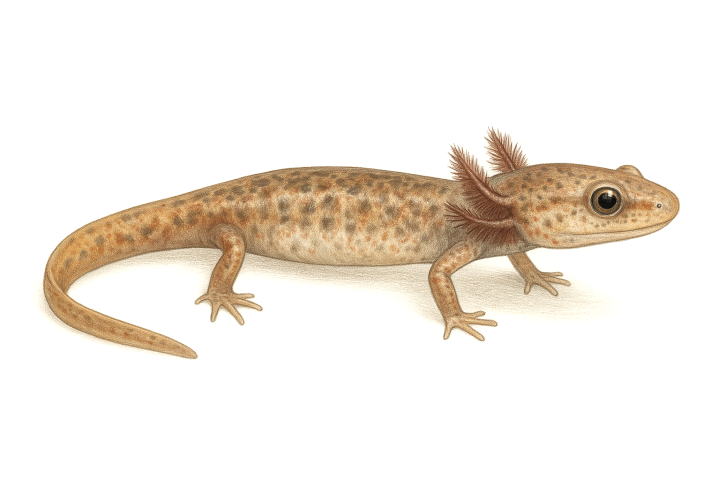
The Barton Springs Salamander is one of those rare gems you can only find in a single place on Earth — the freshwater springs of Austin, Texas. This tiny aquatic amphibian never leaves the water and has adapted to an incredibly specific environment, making it both fascinating and fragile. If you’re visiting Barton Springs, you’re actually stepping into the only known habitat of this endangered little creature!
Size & Physical Appearance
These salamanders are small and slender, usually measuring between 2.5 to 6.5 centimeters (roughly 1 to 2.5 inches) in length. Their skin tends to be translucent gray, purplish, or light brown, often with flecks or speckles that help them blend in with the rocky streambeds. They have external gills — feathery red tufts behind the head — which they use to breathe underwater.
Males and females look very similar, but during the breeding season, males may develop slightly broader heads and swollen cloacal areas. Juveniles are similar in appearance but usually lighter in color and, of course, smaller.
Habitat and Range
As the name suggests, the Barton Springs Salamander is only found in and around Barton Springs — a group of natural springs in Zilker Park in Austin, Texas. That’s it. This species has one of the most restricted ranges of any amphibian in the United States.
They live in cool, clear waters that emerge from limestone aquifers like the Edwards Aquifer. Because they rely on constant, high-quality spring water, they’re extremely sensitive to pollution, groundwater depletion, and changes in water temperature.
You’ll find them hiding among gravel, rocks, or aquatic vegetation in spring outflows. The water here stays around 68–72°F year-round, which is perfect for these salamanders.
Diet
Barton Springs Salamanders feed on tiny aquatic invertebrates. Their menu includes:
- Freshwater snails
- Small crustaceans like amphipods
- Midge and mosquito larvae
- Other microinvertebrates living in the spring water
They’re sit-and-wait predators, meaning they often remain still and snap up prey that swims by. Their small size limits their options, but they’re pretty efficient hunters for their scale.
Lifespan
In the wild, their lifespan is still being studied, but it’s estimated to be around 5 to 10 years. In captivity, they can live longer — up to 11 years — under stable conditions.
Identification Tips
If you’re trying to spot a Barton Springs Salamander, look for:
- External red gills extending from the sides of the head
- Translucent or light-colored skin with scattered pigmentation
- Slender, elongated bodies with a short snout
They can be easily confused with the closely related Austin Blind Salamander (Eurycea waterlooensis), which also lives in the Barton Springs area. However, the Austin Blind Salamander lacks functional eyes and is generally more pale and reclusive, spending more time underground.
Also, the Jollyville Plateau Salamander (Eurycea tonkawae) looks similar but lives in spring systems to the north of Austin, not the immediate Barton Springs area.
Fun Fact
The Barton Springs Salamander was actually discovered relatively recently — in the early 1990s — and was named in honor of local citizens (hence the species name “sosorum”) who advocated for preserving the springs and protecting its endangered inhabitants. It’s a great example of how local conservation efforts can lead to the formal recognition and protection of a species.
Final Thoughts
This tiny animal might not look like much at first glance, but it plays a big role as an indicator species. Its health tells scientists a lot about the water quality in Barton Springs and the overall health of the Edwards Aquifer. If you’re ever swimming in Barton Springs Pool, take a moment to appreciate the incredible biodiversity hiding right under the surface — the Barton Springs Salamander might just be watching your every move from the pebbles below.
Just remember: look, don’t touch. These salamanders are federally protected, and even small changes in their environment can have big impacts.