
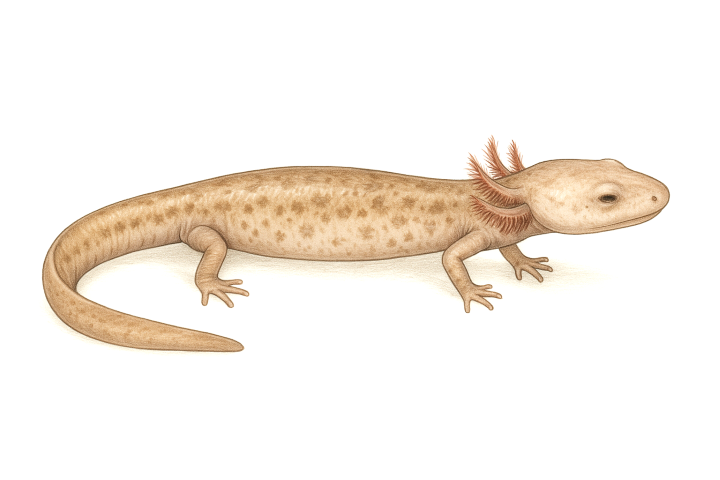
The Georgia Blind Salamander is a mysterious little amphibian that lives its entire life underground — and it doesn’t even have eyes. Yep, you read that right. Found only in a very specific set of subterranean habitats in the southeastern U.S., this salamander has adapted to complete darkness in a way that’s truly fascinating. With its translucent skin and ghostly appearance, it almost looks like a creature from a science fiction story. But it’s 100% real and plays an important role in one of nature’s most hidden ecosystems.
Size & Physical Appearance
The Georgia Blind Salamander is fairly small, typically growing to about 1.5 to 2.5 inches long (4 to 6.5 cm). Its body is slender and eel-like, with a slightly flattened head and a long tail. Most striking is its pale pinkish or whitish coloring, which comes from a lack of pigment — common in cave-dwelling animals.
And of course, there are those tiny, functionless eyes. You can still see where the eyes are, but they’re covered by skin and don’t actually work. That’s because this salamander lives in total darkness and doesn’t need them. There’s not much visual difference between males and females, and juveniles look pretty much like smaller versions of the adults.
Habitat and Range
You won’t find the Georgia Blind Salamander hanging out under garden rocks or near the edge of a pond. This species lives in deep limestone aquifers and submerged caves — environments that stay dark 24/7. It’s a true underground specialist.
Its known range is extremely limited. It has only been found in the Florida Panhandle and southern Georgia, especially near the Flint and Apalachicola Rivers. These salamanders are strongly tied to karst topography — areas with lots of underground limestone formations, caves, and springs.
They’re sometimes found in water-filled sinkholes or wells that connect to aquifers, but their natural world is hard for most of us to even explore.
Diet
Living in total darkness doesn’t stop the Georgia Blind Salamander from finding food. Instead of using eyesight, it relies on sensitive skin and chemical cues in the water to locate prey.
Their diet consists mainly of tiny aquatic invertebrates like isopods, copepods, and insect larvae. Basically, whatever small creatures drift by in the groundwater, the salamander might try to eat. It’s a sit-and-wait predator, snapping up passing prey with a quick strike of its jaws.
Lifespan
There isn’t a ton of data on this species because it’s so hard to observe, but scientists estimate that Georgia Blind Salamanders probably live at least 10 to 15 years in the wild. In captivity — when studied by researchers — they’ve survived similarly long spans, though consistent breeding in captivity has been tricky.
Identification Tips
The Georgia Blind Salamander is pretty easy to ID — but mostly because of where it lives and how it looks.
Here are a few quick tips:
- No functioning eyes: The dark, cave-dwelling environment means it has no need for vision, and its eyes are tiny and covered by skin.
- Pale, almost translucent skin: This ghostly coloring is a dead giveaway for a subterranean species.
- Slender, aquatic body: It’s adapted for gliding through groundwater, not crawling on land.
It can sometimes be confused with other aquatic salamanders like the Dwarf Salamander (Eurycea quadridigitata) or cave-dwelling species in the same genus, but those typically have at least partially functioning eyes and very different habitats. If you’re seeing this salamander, you’re likely in a very specific karst system, and it’s likely this species.
Fun Fact
The Georgia Blind Salamander might not be sightseeing down there, but it’s still in good company. It shares its underground home with another eyeless creature — the rare Albany Cave Crayfish. Scientists believe these species, along with others in the aquifer, are holdovers from ancient times when sea levels and habitats were different. They’ve been evolving together, miles beneath our feet, for thousands (if not millions) of years.
These salamanders are also incredibly sensitive to changes in groundwater quality. That makes them important indicators of underground ecosystem health. So protecting clean water isn’t just good for people — it’s also vital for keeping these hidden salamanders safe.
If you’re exploring the amphibians of the United States, the Georgia Blind Salamander is definitely one of the most unique. It’s hidden, mysterious, and adapted to a life most of us will never see firsthand — and that makes it all the more fascinating.