
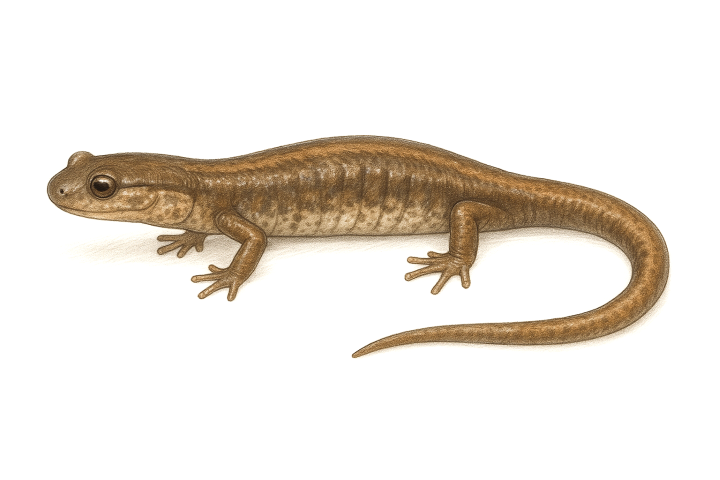
The Greenhorn Mountains Slender Salamander (Batrachoseps altasierrae) is a tiny, secretive amphibian that lives in a very specific slice of California. It’s one of those rare creatures most people never see, but it’s well worth getting to know. With its slim body and quiet lifestyle, this salamander is a true specialist — adapted to a high-elevation life in the rugged Sierra Nevada.
Size & Physical Appearance
This salamander definitely lives up to its “slender” name. Adults typically measure between 1.5 and 2.2 inches in total length, including the tail. Its body is long and thin, and it has rather short legs, giving it a worm-like look when it moves.
Coloration can vary, but most individuals are a mix of brown, tan, or reddish shades with a dusky or dark underside. Some have a faint stripe or mottling along the back, while others are more uniform in color. Juveniles tend to resemble adults but may be darker and show clearer markings.
Habitat and Range
You’ll only find the Greenhorn Mountains Slender Salamander in a very limited area: the Greenhorn Mountains in Kern and Tulare Counties of California. It’s a true local — what scientists call an “endemic” species — meaning it doesn’t occur anywhere else on Earth.
This salamander likes cool, moist environments. It generally stays in mixed conifer forests at elevations from about 3,000 to 7,000 feet. You’re most likely to find one by carefully flipping over leaf litter, rotting logs, or moist rocks on a shady forest floor — though be sure to put everything back where you found it.
Diet
Like many small salamander species, the Greenhorn Mountains Slender Salamander eats tiny invertebrates that it finds in the soil and leaf litter. That includes:
- Insects
- Spiders
- Springtails
- Worms
- Other small critters it can catch and swallow
It’s not a picky eater, but it is a stealthy one — waiting for prey to wander close before lunging with its sticky tongue.
Lifespan
In the wild, slender salamanders like this one can live up to 8 to 10 years, though many don’t make it that long due to natural predators or changes in their fragile habitat. In captivity, their lifespan isn’t well documented, mostly because they’re not commonly kept as pets.
Identification Tips
The Greenhorn Mountains Slender Salamander looks a lot like several other slender salamanders in California, and it can be tricky to tell them apart without close observation or even genetic testing. But here are a few clues:
- Narrow body and short legs make it look almost like a tiny snake with legs
- Tail is long and tapering, often longer than the body
- Found only in the elevation and area of the Greenhorn Mountains
If you’re in that small mountain range and find one of these salamanders, there’s a good chance it’s B. altasierrae. But keep in mind there are over 20 species in the Batrachoseps genus, many of which live nearby.
Fun Fact
The Greenhorn Mountains Slender Salamander is part of a group known as lungless salamanders. That means it doesn’t have lungs at all — instead, it breathes entirely through its skin and the lining of its mouth. That’s why staying moist is critical for its survival.
If its skin dries out, it can’t breathe. This is also why you’ll never find one basking in the sun or wandering around in dry weather.
Final Thoughts
Because of its tiny range and its need for moist forest floor habitat, the Greenhorn Mountains Slender Salamander is vulnerable to changes in climate, logging, and fire. If you’re exploring its mountain home, take a moment to appreciate this hidden local — and as always, watch wildlife without disturbing it.
Whether you’re hiking in the Sierra or just curious about California’s stunning biodiversity, this little salamander is a great reminder that even the smallest creatures can be special, and sometimes the rarest wildlife is hiding right under your feet.