
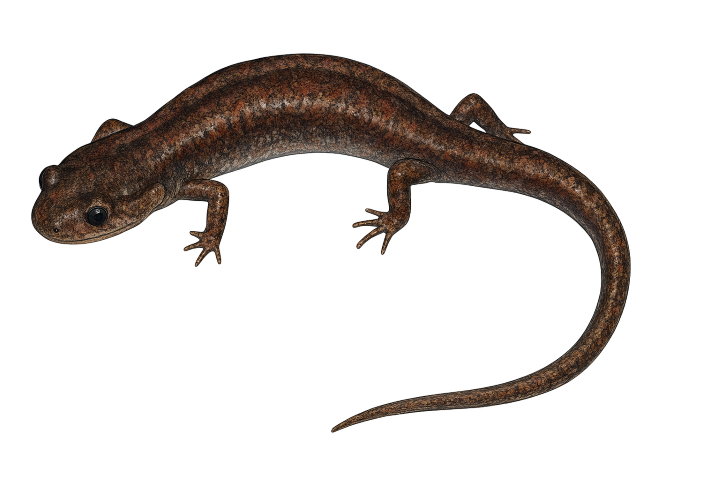
The Tehachapi Slender Salamander is a fascinating little amphibian that lives a secretive life in the mountains of Southern California. It’s rarely seen by people—partially because of its remote habitat, and partially because it’s tiny, quiet, and incredibly good at hiding. What makes this salamander special? For starters, it breathes entirely through its skin and mouth lining—no lungs at all! It’s also one of the few amphibians that exists only in a very small part of California, making it a true local treasure.
Size & Physical Appearance
This is a small and slender salamander, usually growing to about 1.5 to 2.3 inches (3.8 to 5.8 cm) from snout to vent. With the tail, which can be quite long, they may reach about 5 inches total.
Color-wise, Tehachapi Slender Salamanders are typically dark brown to black with a lighter reddish, tan, or copper-colored stripe running down their back. Their skin looks smooth and moist, as you’d expect from a salamander that relies on skin breathing. Their tiny legs and narrow heads give them an almost worm-like appearance, especially when they move in their slow, careful way.
Males and females look pretty similar to the naked eye, especially out in the field. Juveniles also resemble adults but tend to be slightly more transparent or lighter in color when they’re freshly metamorphosed.
Habitat and Range
This salamander is found only in a very small region: the Tehachapi Mountains of Southern California, specifically in parts of Kern County. It lives in oak woodlands, mixed evergreen forests, and sometimes chaparral, often in cool, moist microhabitats like beneath leaf litter, under logs, or in shaded crevices. Most sightings occur at elevations between about 2,500 and 6,000 feet.
Because they’re so moisture-sensitive and can dry out quickly, they tend to stay underground or hidden during hot or dry periods, emerging mostly in the cooler, wetter months of fall and winter.
Diet
Tehachapi Slender Salamanders eat a variety of small invertebrates. Their diet includes:
- Tiny insects
- Springtails
- Mites
- Spiders
- Small worms and other soil-dwelling critters
They’re opportunistic feeders, meaning they’ll eat whatever small prey is available in their damp habitats. Since their range is so limited, they’re especially tied to the health of the micro-ecosystems they live in.
Lifespan
In the wild, their lifespan is not well documented, but similar species can live anywhere from 5 to 10 years. In captivity (which is rare for this species), they might live slightly longer under the right conditions.
Identification Tips
At a glance, Tehachapi Slender Salamanders might be confused with other slender salamander species like Batrachoseps nigriventris (the Black-bellied Slender Salamander). Here are a few ways to tell them apart:
- Location is key – If you’re in the Tehachapi Mountains, chances are you’re looking at Batrachoseps stebbinsi, since its range is so limited and specific.
- Body proportions – Compared to some relatives, this salamander has a relatively broad head and long limbs for its group.
- Color and pattern – The Tehachapi Slender Salamander usually has a copper or tan dorsal stripe over a darker body, though this can vary depending on light and individual variation.
Still, these ID differences can be subtle, and experts often rely on genetics or geographic data to confirm species.
Fun Fact
Unlike frogs or toads, this salamander doesn’t have lungs at all—it uses something called cutaneous respiration, meaning it “breathes” directly through its skin and the lining of its mouth. That’s why it needs to stay moist—dry skin means it literally can’t breathe!
Behind the Scenes: Why This Salamander Matters
Because it lives in such a narrow part of the Tehachapi Mountains, this species is especially sensitive to habitat changes from things like development, climate change, or fire. Scientists keep a close eye on it to help monitor the health of oak woodland and mountain ecosystems in Southern California.
If you’re lucky enough to visit this area, please remember to leave logs and rocks where they are—salamanders and lots of other critters rely on those hidden, damp places to survive.
In Summary
The Tehachapi Slender Salamander may be small and secretive, but it’s an important piece of California’s wild heritage. With its lungless body, narrow range, and earthworm-like look, it’s a great reminder of just how diverse and specialized amphibians can be.
Looking to learn more about other slender salamanders in California or the rest of the U.S.? Stick around—there are dozens of species to discover, each with its own quirks and stories.