
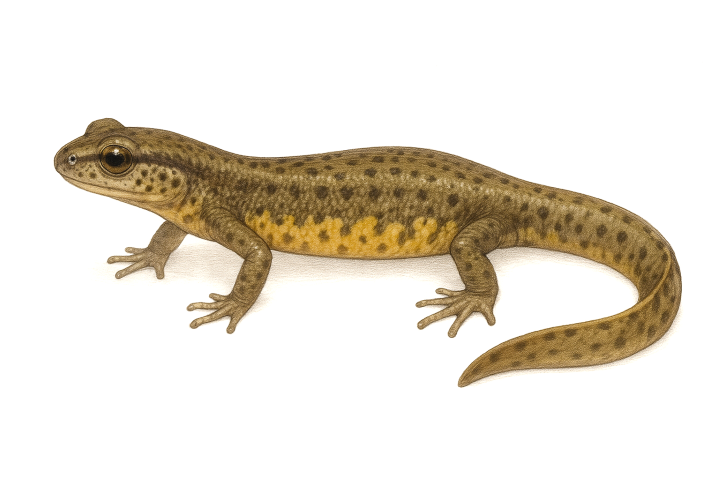
The Cascade Torrent Salamander is a small, secretive amphibian that lives in fast-flowing, cold mountain streams. These little guys are specially adapted to life in the chilly waters of the Pacific Northwest. What makes them really interesting is how picky they are about their habitat — they need pristine, clean streams and moist forest floors to survive. If you’re lucky enough to spot one, you’re looking at one of nature’s most specialized salamanders.
Size & Physical Appearance
The Cascade Torrent Salamander is on the smaller side, growing to about 2 to 4 inches in total length. Their bodies are slender with relatively short limbs and a squared-off snout.
They usually have a yellow to orangey-yellow underside dotted with small, dark spots, while their back is typically brown or olive. Some individuals may have a hint of green. Juveniles tend to be duller than adults and can be tough to spot due to their tiny size and camouflage.
There’s not much difference between males and females when it comes to appearance, though males tend to have slightly longer limbs and might show a little swelling at the cloaca during breeding season.
Habitat and Range
As the name suggests, Cascade Torrent Salamanders live in the Cascade Mountains of Oregon and Washington. Their range is pretty limited and tied tightly to their stream-loving lifestyle.
They prefer cold, fast-moving streams and seeps in dense coniferous forests. You’ll usually find them around mossy rocks, under logs, or tucked into the gravel near stream edges. Most live at elevations between 300 to over 4,000 feet, depending on the location.
These salamanders are highly sensitive to changes in water quality and temperature, which makes them good indicators of ecosystem health. Logging, development, and sedimentation can all threaten their habitat.
Diet
Cascade Torrent Salamanders eat a variety of small invertebrates. Their diet includes:
- Insect larvae
- Small crustaceans
- Worms
- Tiny aquatic insects like mayflies and caddisflies
They’re ambush predators — they hide in crevices or under gravel and wait for prey to come within striking distance. Because they live in fast-moving water, they’ve developed quick reflexes to catch food before it’s swept away.
Lifespan
In the wild, Cascade Torrent Salamanders can live anywhere from 8 to 10 years, possibly longer. In captivity, they’re rarely kept because of how specific their habitat needs are. That makes it tricky for researchers to determine just how long they might live under ideal conditions.
Identification Tips
This salamander is easy to mix up with a couple of its close relatives — especially other torrent species like the Columbia Torrent Salamander (Rhyacotriton kezeri) and the Olympic Torrent Salamander (Rhyacotriton olympicus).
Here’s how you can tell them apart:
- Yellow-orange belly with distinct dark spots – more pronounced than in some relatives.
- Lacks a nasolabial groove (a facial groove found in many other salamanders).
- Square jaw and blunt snout – gives them kind of a boxy-looking head.
- Check the location: if you’re in the central Oregon Cascades, you’re probably looking at a Cascade Torrent Salamander.
Fun Fact
These salamanders don’t have lungs — they breathe entirely through their skin and the lining of their mouths! That’s why they need constantly moist environments with high oxygen levels. If a stream dries up or gets polluted, these salamanders are often the first to disappear.
In Summary
The Cascade Torrent Salamander may be small, but it’s a big deal when it comes to freshwater ecosystems. If you’re exploring a cool, shady forest in the Cascades and come across a tiny, spotted salamander hiding near a cold stream, you might have just found one. It’s a good reminder of how important clean water and wild spaces are — not just for us, but for all the unique creatures that call them home.