
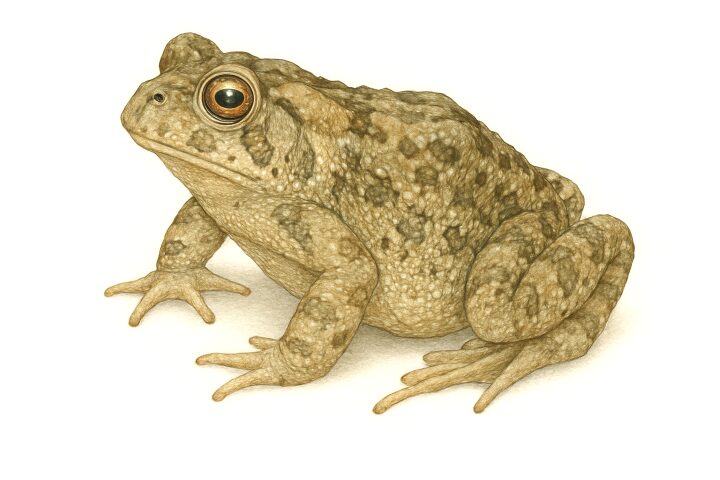
If you’ve ever heard a loud, drawn-out “waaaaaaaaah” coming from a roadside ditch or neighborhood pond on a summer night, chances are you’ve met a Woodhouse’s Toad (Anaxyrus woodhousii). These hardy amphibians are some of the most common toads across the central and western U.S., and they’ve got a voice that’s hard to forget. Despite their plain appearance, they’re full of personality and surprisingly adaptable to life near people.
Size & Physical Appearance
Woodhouse’s Toads are medium to large-sized toads, typically growing between 2.5 to 4.5 inches in length. They’re usually a gray or brownish color, often speckled with darker blotches and a washed-out pale stripe running down the center of the back.
Their skin has the classic dry, bumpy texture you’d expect from a toad. Males tend to be smaller and slimmer than females and may have a darker throat—especially noticeable during breeding season when they’re calling. Juveniles are like smaller versions of adults but with less defined markings and sometimes a greener tint.
Habitat and Range
One of the most impressive things about the Woodhouse’s Toad is how versatile it is when it comes to habitat. You’ll find these toads in all sorts of environments, from desert washes and grasslands to woodland edges, suburbs, and even vacant lots in cities.
Their range extends across much of the central and southwestern United States, including states like Texas, Oklahoma, Kansas, Colorado, Utah, Arizona, New Mexico, and parts of the Midwest and West Coast. They’re also found from sea level up to about 8,000 feet in elevation, so keep an eye (or ear) out whether you’re in the lowlands or the mountains.
Woodhouse’s Toads are particularly fond of areas near water—especially for breeding—but they also thrive in dry or disturbed areas as long as there are insects to eat and moisture for hiding during the day.
Diet
These toads are all about the bugs. Their diet mainly includes insects like beetles, ants, and crickets, but they’ll happily eat just about any creepy-crawly that fits in their mouth.
Woodhouse’s Toads are nocturnal foragers, which means they come out at night to hunt by ambush. They use their sticky tongues to snatch up unsuspecting insects within range. In suburban areas, they’re often spotted under porch lights where bugs gather at night—bringing a natural pest control service right to your backyard.
Lifespan
In the wild, Woodhouse’s Toads typically live for about 5 to 8 years, though individuals have been known to survive longer under the right conditions. In captivity, with protection from predators and stable food and water, some may live even longer—up to 10 years or more.
Identification Tips
Woodhouse’s Toads can look a lot like other toads, especially the American Toad and the Great Plains Toad. Here’s how to tell them apart:
- Woodhouse’s Toad has a prominent light stripe down the middle of its back and large, oval-shaped parotoid glands (the raised bumps behind their eyes).
- They usually have one or two warts per dark spot on their back. Compare that to the American Toad, which usually has more warts per blotch.
- Their call is a long, nasal “waaaaaaah” that sounds like someone slowly letting air out of a balloon. The Great Plains Toad makes a faster, more metallic trill.
- The cranial crests (raised ridges on the head) of Woodhouse’s Toads form a “V” shape and often connect to the parotoid glands with a short spur.
Get a good look at the head and listen to the call if you’re trying to tell them apart during mating season—that’s your best clue.
Fun Fact
Woodhouse’s Toads have been known to burrow underground to escape heat and drought, sometimes staying buried for weeks or even months. This survival tactic helps them thrive in arid areas where you’d never guess a toad could live. When the rain finally comes, they emerge in large numbers—sometimes overnight—to breed, feed, and rehydrate.
Final Thoughts
Whether they’re belting out their unmistakable calls from a pond or flicking their tongue at a cricket on your patio, Woodhouse’s Toads are a fascinating part of many American landscapes. They’re easy to overlook due to their drab appearance, but once you start noticing them, you’ll be surprised how often they show up.
They’re also a great introduction to amphibians for kids and families—tough, adaptable, and fun to observe. Just remember to give them space and never use pesticides in your yard if you’ve got toads around. They’re great neighbors—and they’ll help keep the bug population in check.