
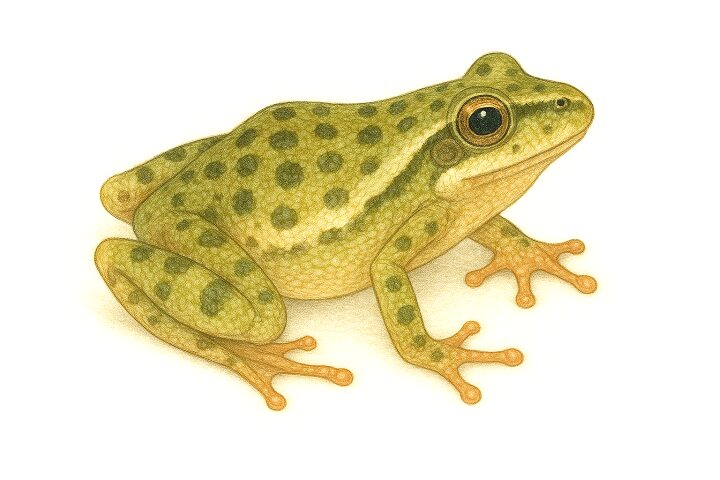
The Spotted Chorus Frog is one of those tiny amphibians you could easily miss — but its cheerful mating call in spring makes it hard to ignore. Despite its small size, this little frog stands out with its eye-catching spots and the surprising variety of places it calls home. It’s part of the chorus frog family, known for their nighttime singing during rainy seasons.
Size & Physical Appearance
These frogs are small — adults usually measure between 1 to 1.5 inches long. That means they’re about the size of a paperclip or your thumbnail.
They’ve got a smooth, gray to greenish background color with scattered dark spots across their back (hence the name). Some individuals have a reddish or brown tint, and there may be a faint line running along their back. A distinctive dark stripe runs from their nose, through the eye, and down to the shoulder.
Juveniles look similar to adults, just smaller and less boldly colored. Males tend to have a slightly darker throat and may be slimmer than females.
Habitat and Range
Spotted Chorus Frogs live mostly in the central southern U.S. They can be found in parts of Texas, Oklahoma, Kansas, Nebraska, Colorado, New Mexico, and into northern Mexico.
They prefer prairies, grasslands, open woodlands, and even agricultural fields. During the warmer months, you might find them hiding under debris or burrowed underground to escape the heat. Like many chorus frogs, they’re most visible during the breeding season in spring when temporary pools and roadside ditches become their stage.
They’re usually found at low to mid elevations. Because they can tolerate dry conditions better than many other amphibians, they’ve adapted well to life in the semi-arid plains.
Diet
These frogs are insectivores, relying mostly on small, soft-bodied insects. Their typical menu includes:
- Ants
- Flies
- Beetles
- Spiders
- Springtails and other tiny invertebrates
They’re sit-and-wait predators, often pouncing quickly when something tasty crawls by. Their small size means they stick to small prey, but they’re quite efficient hunters.
Lifespan
In the wild, Spotted Chorus Frogs typically live around 3 to 5 years. In captivity, with consistent care and protection from predators, they may live a little longer, although they’re not kept as commonly as some other frog species.
Identification Tips
One of the key challenges is telling the Spotted Chorus Frog apart from similar species such as the Boreal Chorus Frog or Western Chorus Frog. Here are some tips to help:
- Look for irregular dark spots on the back – more scattered and blotchy than the straight or broken stripes seen in some other chorus frogs.
- Notice the greenish or olive color some individuals display — other chorus frogs tend to be more tan or brown.
- Listen to the call! The main clue is in the sound. The Spotted Chorus Frog’s call is a short, raspy trill — a bit like running a finger over a plastic comb. It’s distinct from the longer, smoother trill of the Boreal Chorus Frog.
If you’re in central Texas or parts of the southern Great Plains during spring rains, chances are good you’re hearing a Spotted Chorus Frog.
Fun Fact
These frogs are named for their looks, but they’re even more famous for their burrowing ability. Unlike many frogs that stick to water or damp areas, Spotted Chorus Frogs can burrow underground during dry periods and emerge when conditions are just right — usually when spring rains trigger breeding season. It’s a great survival trick for life in drier climates.
In Summary
The Spotted Chorus Frog is a small but fascinating part of the North American amphibian chorus. With its bold spots, burrowing habits, and peeping spring calls, it’s a great example of how even the tiniest creatures have big personalities. Whether you’re a backyard frog-watcher or heading out to a prairie at dusk, keep an eye (and ear) out for this spotted singer.