
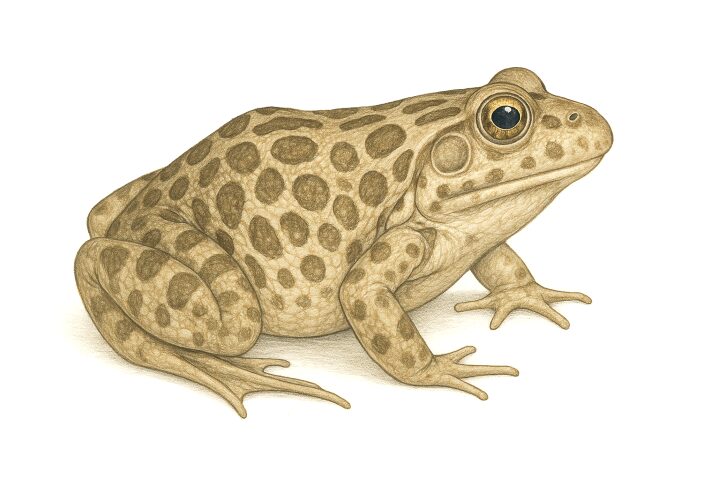
The Crawfish Frog is a quirky, secretive amphibian with a name that fits its lifestyle. Named for its strong association with crayfish burrows, this chunky frog spends most of its life underground. You’re not likely to spot one unless you’re near its breeding ponds in early spring — and you might hear it before you see it. Its loud, low-pitched call carries across grassy fields and sounds a bit like a distant snore.
Size & Physical Appearance
Adult Crawfish Frogs are fairly large, typically measuring between 2.5 to 4 inches in length. They’re stocky, with a big round body and relatively short legs compared to other frogs in the same family.
What really sets them apart is their striking color pattern. Their skin is tan, yellowish, or brown with large, dark-edged circular spots scattered across the back and sides. These spots usually have a light border, giving them a bold, polka-dot look. The belly is pale and unmarked.
Males and females look similar, though males tend to be a bit smaller and have darker throats during the breeding season. Juveniles look like miniature adults but with less intense coloration.
Habitat and Range
Crawfish Frogs are mostly found in the central and southeastern United States. Their range includes parts of Indiana, Illinois, Missouri, Kansas, Arkansas, Oklahoma, Texas, Mississippi, and Louisiana, with scattered populations in nearby states. They’re more common in areas that haven’t been heavily developed or converted to agriculture.
This frog prefers open, grassy habitats like prairies and pastures. They often rely on old crayfish burrows for shelter, which provide them protection from predators and the hot, dry conditions above ground. These burrows can be over a foot deep, so it’s a stable place for them to hang out for months at a time.
During breeding season, they’ll migrate — sometimes surprisingly long distances — to fishless wetlands, temporary ponds, or shallow pools to lay eggs.
Diet
Crawfish Frogs are ambush predators. They’ll perch near the mouth of a crayfish burrow and wait for insects or other small animals to wander by — then strike with their sticky tongue. Their diet includes bugs like:
- Grasshoppers
- Spiders
- Crickets
- Beetles
- Occasionally other small frogs or even small snakes
Because they spend so much time underground, they’ve adapted to grab whatever edible creature happens to pass the burrow’s entrance.
Lifespan
In the wild, Crawfish Frogs typically live about 7 to 10 years, though some may live longer under the right conditions. In captivity, their lifespan might be longer, but they’re not commonly kept as pets or in zoos due to their specific habitat needs.
Identification Tips
Crawfish Frogs are often confused with their close relatives, especially the Plains Leopard Frog and the Southern Leopard Frog. But there are a few key differences:
- Crawfish Frogs have large circular spots with light borders, while leopard frogs tend to have more irregular, blotchy spots.
- The skin of the Crawfish Frog is noticeably smooth and glossy, especially when wet.
- The (those ridges that run down their backs) stop abruptly once they reach the groin in Crawfish Frogs. In leopard frogs, those folds usually extend the whole length of the back.
If you find a frog deep in a burrow in prairie habitat, especially in the spring or fall, there’s a good chance it’s a Crawfish Frog.
Fun Fact
Despite the name, Crawfish Frogs don’t eat crayfish — they live with them! These frogs rely on abandoned (or sometimes still-occupied) crayfish burrows for shelter. Some scientists believe this dependence is one reason the species is declining in parts of its range — fewer natural prairies and healthy crayfish populations mean fewer suitable homes.
Whether you’re a wildlife watcher keeping your ears open during spring nights or a frog fan hoping to spot a rarely seen burrow-dweller, the Crawfish Frog is a reminder of how clever and specialized amphibians can be. Keep your eyes on the prairie and your ears to the ground — literally. Their snoring call might just lead you to a hidden frog treasure.