
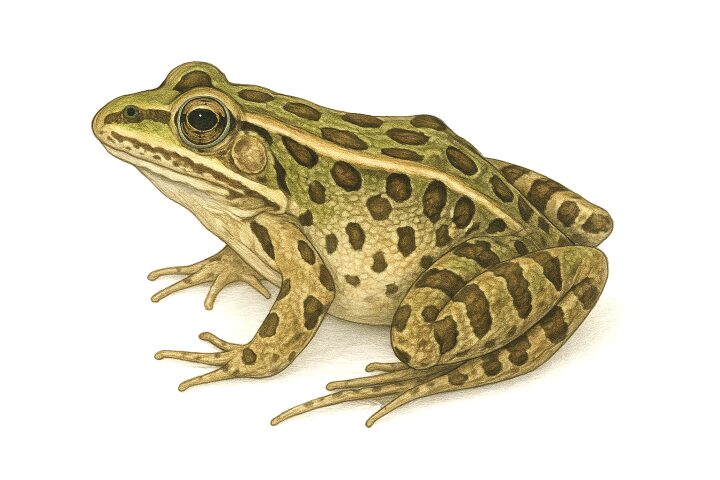
The Northern Leopard Frog is one of those amphibians that’s hard to miss — thanks to its bold, leopard-like spots and impressive leap. It’s also one of the most widely recognized frogs in North America, especially in the northern United States and Canada. Named for its distinctive markings, this frog has a surprisingly important role in both wetland ecosystems and scientific research.
Size & Physical Appearance
Northern Leopard Frogs are medium-sized frogs, typically measuring between 2 to 4.5 inches long. They tend to be green or brown with dark, rounded spots scattered across their back and legs — kind of like a leopard’s markings, which is where they get their name.
These spots are usually outlined in a lighter color, and you’ll notice two bright dorsolateral folds (those noticeable ridges) that run from behind the eyes down the back. Their belly is pale or white.
Males are usually smaller and may have darker throats during the breeding season. Juveniles look like mini versions of the adults but may be duller in color and have less defined spots.
Habitat and Range
Northern Leopard Frogs live in a wide range of habitats, but they especially like permanent bodies of water like ponds, lakes, and marshes, surrounded by grasslands or meadows. They’re often found near slow-moving streams or wetlands with plenty of aquatic vegetation.
You can find them throughout much of the northern United States, particularly in the Midwest, Northeast, and parts of the Rocky Mountains. States where they’re common include Montana, Minnesota, Wisconsin, New York, and Vermont, among others.
They’ll also wander into fields and grassy areas during the summer, sometimes quite a distance from water. Elevation-wise, they can live from lowland areas up into the foothills and montane zones.
Diet
Northern Leopard Frogs are opportunistic feeders — if it moves and they can catch it, they’ll probably eat it. Their diet includes:
- Insects (like crickets, beetles, and flies)
- Spiders and snails
- Worms
- Occasionally smaller frogs and even small birds or mammals (in rare cases!)
They’re surprisingly ambitious for their size and have even been known to stalk prey before pouncing.
Lifespan
In the wild, Northern Leopard Frogs can live around 4 to 6 years. In captivity, with the right care, some have lived up to 9 years or more.
Identification Tips
Here’s how to tell a Northern Leopard Frog apart from similar species:
- Spots: Look for the characteristic dark spots surrounded by lighter halos. These are more rounded and orderly than the markings on other frogs.
- Dorsolateral folds: The two light ridges down the back stand out and run in relatively straight lines from behind the eyes to the lower back.
- Call: Males sound a bit like a snore or a long, low growl during breeding season — not the classic “ribbit” you’re expecting.
Don’t confuse it with the Pickerel Frog, which also has spots but tends to have more rectangular blotches and a yellowish-orange wash on its inner thighs.
Fun Fact
The Northern Leopard Frog has been a bit of a celebrity in science labs. For years, it’s been used in biology and medical research due to its manageable size, availability, and relatively hardy nature.
In a Nutshell
If you’re out walking near a pond in spring or early summer and see a frog with springy legs and a fashionable spotted pattern, you’re probably looking at a Northern Leopard Frog. It’s a great species to learn about — whether you’re a student, a teacher, or just someone who loves the outdoors.
Keep your eyes (and ears) out during the breeding season, and you might catch them chorusing in unison on a warm evening. It’s one of nature’s most charming concerts.