
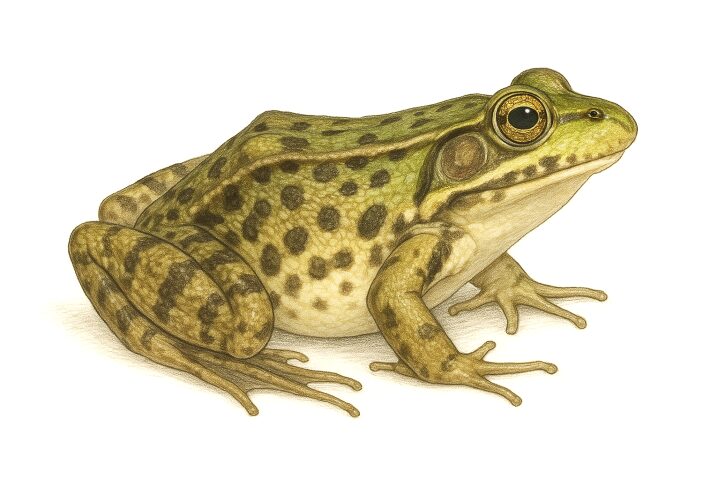
If you ever find yourself sitting quietly near a pond up north and hear a sound like clinking bottles or a soft knock-knock-knock, chances are there’s a Mink Frog nearby. These secretive frogs are experts at blending in and are found primarily in the northeastern U.S. What really makes the Mink Frog unique? That musky smell — yep, just like a mink, which is how they got their name.
Size & Physical Appearance
Mink Frogs are on the smaller side compared to other frogs in their range. Adults usually measure 1.75 to 3 inches long, with females often being a bit larger than males. They’re generally green or olive-colored, with irregular darker spots or mottling on their backs and legs.
What really stands out is their skin — it’s smooth but looks a bit mottled, often with a kind of marbled pattern. Their legs are long and strong, perfect for swimming. Their belly tends to be light cream or yellowish.
Males and females look pretty similar, but during the breeding season, males may show swollen thumbs and have a darker throat. Juveniles often have a cleaner appearance with less spotting.
Habitat and Range
Mink Frogs are strong fans of northern wetlands. They’re most commonly found in cool, heavily vegetated lakes, ponds, and slow-moving streams, especially those with lots of lily pads or aquatic vegetation to hide in.
Geographically, look for them in northern Minnesota, Wisconsin, Michigan, and parts of New York and New England. They’re also widespread in much of Canada. These frogs prefer cooler climates and are rarely found too far south.
They tend to hang out at low to mid elevations, usually no higher than 1,500 feet.
Diet
These frogs are mostly nocturnal when it comes to feeding. Mink Frogs are opportunistic carnivores, which just means they’ll eat whatever small prey comes their way. Their menu includes:
- Insects (like beetles, flies, and mosquitoes)
- Spiders
- Ants
- Small aquatic invertebrates
Tadpoles feed on algae and other plant material, but once they transform, it’s all about protein.
Lifespan
In the wild, Mink Frogs typically live about 4 to 6 years. Not a lot is known about their lifespan in captivity since they’re not commonly kept as pets or research animals. They probably live a bit longer in protected environments, but nobody knows for sure.
Identification Tips
It’s pretty easy to confuse Mink Frogs with some of their neighbors like the Green Frog or Pickerel Frog, but here are some clues to help you tell them apart:
- Mink Frogs lack dorsolateral ridges — those raised lines that run from behind the eyes down the back. Green Frogs have these.
- Mink Frogs often have more irregular mottling on their legs, rather than the clean, paired rectangular spots you’d see on a Pickerel Frog.
- Their call is very distinctive — if you hear something that sounds like tapping or distant hammering on wood, that’s a good sign it’s a Mink Frog.
- They give off a noticeable musky odor if handled, which is where they get their name.
If you’re not sure, location can help too. If you’re in the north woods and it’s a cooler wetland, Mink Frog is a strong candidate.
Fun Fact
You might not expect a frog to smell like a fur-bearing mammal, but the Mink Frog’s musky scent is famous among herpetologists and field researchers. Some even describe it as a combination of skunk and overripe cucumbers. It’s believed to be part of their natural defense against predators — a kind of built-in stink bomb!
Whether you’re hiking around a quiet lake in Minnesota or poking around the edges of a northeastern pond, keep an eye (and an ear… and maybe even a nose) out for Mink Frogs. They’re not flashy, but they’re a fascinating little piece of the northern wetland puzzle.