
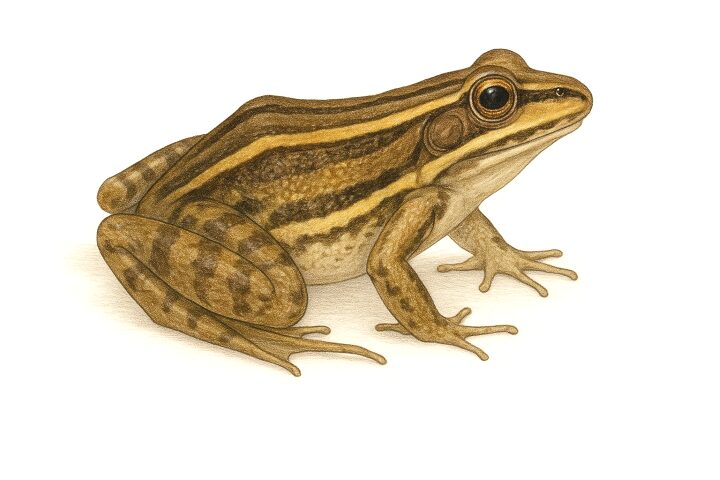
The Carpenter Frog is a small, secretive amphibian with a big personality — at least when it comes to its voice. It gets its name from the sharp, repetitive call that sounds a lot like a carpenter hammering nails. This frog is most often heard rather than seen, hidden among dense vegetation near blackwater swamps and bogs in the eastern United States. If you’re exploring wetlands in the Southeast during spring or summer evenings, chances are you’ve heard one — even if you didn’t know it.
Size & Physical Appearance
Carpenter Frogs are modest in size, measuring about 1.5 to 2.5 inches long. Their coloring is quite distinctive: they have a warm brown base color with two bold, yellow or gold stripes running down each side of the body from the eyes to the rear legs. You might also notice dark spotting or mottling on their back and legs.
Unlike many other frogs, Carpenter Frogs don’t have ridges (called dorsolateral folds) running down their backs, which can be a clue when you’re trying to ID them. Males and females look similar, though males are generally smaller and have darker throats.
Habitat and Range
These frogs are pretty picky about where they live. Carpenter Frogs are strongly associated with acidic wetlands like blackwater streams, sphagnum bogs, swamps, and cypress ponds. They tend to avoid fast-moving or clear water, preferring areas with lots of vegetation and leaf litter.
Their range is fairly narrow — they’re mostly found in the Coastal Plain region of the southeastern United States, from southern New Jersey down through eastern North Carolina, South Carolina, and into southeastern Georgia. They’re most common in low elevation environments below about 600 feet.
Diet
In the wild, Carpenter Frogs feed on a variety of small invertebrates. Their diet includes ants, beetles, flies, spiders, and small aquatic insects. They’ll eat pretty much anything they can catch and swallow.
One fun detail: they’re ambush predators. That means they prefer to sit still and wait for prey to come close, rather than hopping around to chase their next meal.
Lifespan
In the wild, the average lifespan of a Carpenter Frog is around 3 to 5 years. Exact data are limited since they’re such a secretive species, but some individuals in protected environments have been known to live longer. Their lifespan in captivity isn’t well documented, mostly because they’re rarely kept as pets or in science collections.
Identification Tips
Carpenter Frogs can be tricky to tell apart from similar species like the Southern Leopard Frog or Green Frog. Here’s how to identify them:
- Distinctive stripes: Carpenter Frogs have two crisp, bright yellow or golden lines down each side. Many similar species may have spots or blotches, but not these side stripes.
- No dorsolateral folds: That means no raised ridges along the back like you’d see in a Green Frog or Leopard Frog.
- Unique call: Their vocalization is one of the best ways to identify them. It sounds like a series of rapid, wooden taps — almost like someone hammering. It’s very different from the croaks or chuckles of other frogs in the area.
If you’re trying to spot one visually, good luck — they’re shy and often dive underwater at the first sign of movement. But if you follow your ears around wetlands in their range, you might just find one.
Fun Fact
Carpenter Frogs are one of the few frog species in North America that live almost exclusively in acidic wetlands. Not only can they tolerate these tough environments, but they’ve evolved to thrive there — in fact, the acidic water helps reduce competition from other frog species that can’t handle it.
So, the next time you’re in a quiet swamp and hear what sounds like someone hammering in the distance… keep your ears open. It might just be a little Carpenter Frog staking out his territory.