
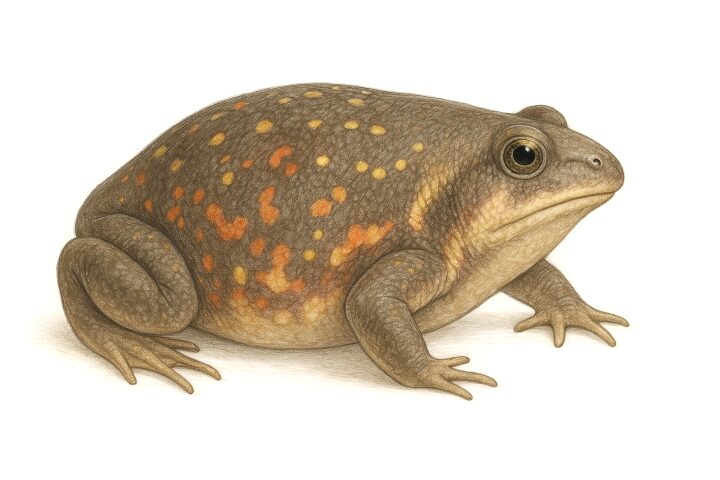
The Mexican Burrowing Toad might just be one of the strangest-looking amphibians you’ll ever meet. With its rounded body, tiny head, and bloated appearance, it looks more like a living balloon than a toad. But don’t let the goofy look fool you — this species is a survival specialist. It spends most of its life hidden underground and only comes out during heavy rains to breed. If you’re lucky enough to spot one, it’s a rare and fascinating glimpse into the hidden world of amphibians.
Size & Physical Appearance
These toads are on the larger side, typically measuring between 2.5 to 3.5 inches long. Their body is stout and rounded, with a surprisingly small head that narrows into a pointed snout — think of a smooshed football.
They have a unique color pattern: dark gray or brownish-black on the back with a bright orange or red stripe that runs from their head down the center of the back. Their belly is lighter, usually a dirty whitish color. Males and females look very similar, though females tend to be slightly larger.
Habitat and Range
Despite the name, the Mexican Burrowing Toad isn’t just found in Mexico. It also lives in extreme southern Texas, mostly in the Lower Rio Grande Valley. It thrives in loose, sandy or loamy soils where it can burrow easily.
This toad prefers lowland tropical and subtropical regions, especially near seasonal ponds or temporary wetlands formed by rain. It spends the vast majority of the year underground, emerging only for a few days after heavy rainfall to breed. So unless you’re out during one of these short windows, you probably won’t see one.
Diet
These toads are insectivores with a strong focus on ants and termites. Their tongue is not like other toads — it projects straight out the front of the mouth (rather than flipping out), and it’s especially suited for scooping up tiny insects underground.
This diet works well with their burrowing lifestyle, allowing them to feed below the surface where ants and termites are abundant.
Lifespan
In the wild, the Mexican Burrowing Toad is thought to live around 10 years, though exact data is limited due to how secretive they are. In captivity, they can sometimes live even longer under stable conditions.
Identification Tips
If you ever see one, it’s pretty hard to confuse it with any other amphibian in the U.S. But just in case, a few features stand out:
- Rounded body with a disproportionately small, pointed head.
- Red or orange stripe down the back — not found on most other toads.
- No visible neck, and eyes are small and close together.
- Very smooth, almost shiny skin (unlike the bumpy skin of true toads).
Some people may confuse them with spadefoot toads, but spadefoots have more pronounced eyes, visible parotoid glands, and longer limbs. Also, burrowing toads make a distinctive low, bleating call that sounds a bit like a sheep — completely different from most frog calls.
Fun Fact
The Mexican Burrowing Toad is the only species in its entire family — Rhinophrynidae. That means it’s the last of its evolutionary lineage, a living fossil of sorts that’s been around for millions of years. It’s like meeting a distant cousin from the age of the dinosaurs!
Bottom Line
The Mexican Burrowing Toad is a true oddball in the amphibian world — and we mean that in the best way. Its round body, underground lifestyle, and strange breeding habits make it one of the most unique amphibians in North America. Though it’s rarely seen, just knowing it’s out there, living quietly beneath our feet, adds a bit of mystery to the natural world.
If you live in South Texas or are visiting during the rainy season, keep your ears open. You just might hear that sheep-like call — and if you’re really lucky, spot one of these remarkable creatures above ground.