
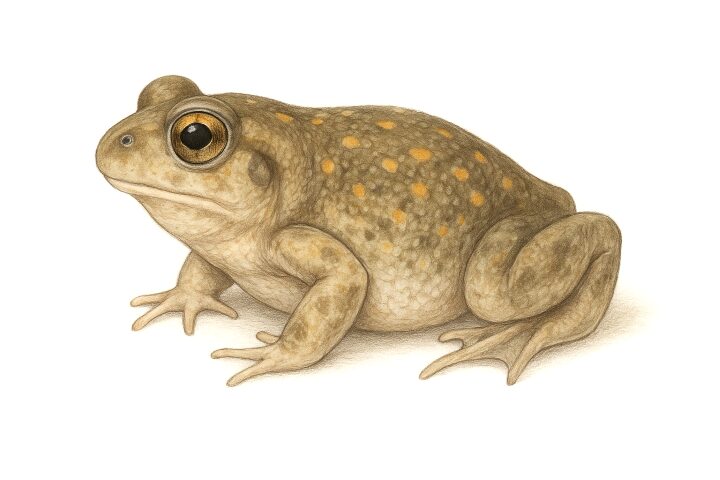
The Mexican Spadefoot is a quirky little amphibian with some serious survival skills. What makes this toad stand out is its ability to live in some of the driest parts of the southwestern United States — and still thrive. With its big cat-like eyes and a knack for appearing only after heavy rains, this secretive species is full of surprises.
Size & Physical Appearance
Mexican Spadefoots are small, usually around 1.5 to 2.5 inches long. Their bodies are round and squat, with short legs and a distinctive wedge-shaped bump (the “spade”) on each hind foot that helps them dig quickly into the soil.
Color varies quite a bit, but they’re usually gray, brown, olive, or greenish, often with irregular darker spots or mottling on their backs. Their bellies are lighter and usually plain. One of their most striking features is their large, golden or copper-colored eyes with vertical pupils — think cat or snake eyes.
Males and females look pretty similar, but during breeding season, males may be slightly smaller and develop darker throats.
Habitat and Range
Unlike the name might suggest, the Mexican Spadefoot isn’t just found in Mexico. In the United States, it lives primarily in the southwestern states, including Arizona, New Mexico, Texas, Utah, Colorado, and parts of Oklahoma. It thrives in arid and semi-arid environments like grasslands, scrub, prairies, and desert flats.
What really makes this amphibian unique is its connection to rain. They spend most of the year buried underground (thanks to that spade on their foot), only emerging for a few days or weeks after a good rainstorm to breed in temporary pools and puddles. They’re adapted to elevations from low desert floors up to around 7,000 feet, depending on local conditions.
Diet
In the wild, Mexican Spadefoots mainly eat insects and other small invertebrates. That includes things like beetles, ants, spiders, crickets, and termites. Because they’re only active above ground for short windows of time, they make the most of it by feeding heavily when they can.
Tadpoles have some unusual behavior too — they develop rapidly (sometimes in just a week or two) and can be omnivorous or even carnivorous, depending on food availability. Some tadpoles even eat fairy shrimp or other tadpoles. It’s a race against the clock before their pool dries up.
Lifespan
In the wild, Mexican Spadefoots live around 6 to 10 years, although their lifestyle makes it hard to track them precisely. In captivity, where there are no predators or droughts to worry about, they can live a bit longer.
Identification Tips
It’s easy to confuse the Mexican Spadefoot with other spadefoot toads, especially the Plains Spadefoot (Spea bombifrons) and Couch’s Spadefoot (Scaphiopus couchii). Here’s how to tell them apart:
- Eye pupil shape: Mexican Spadefoot has vertical, cat-like pupils. Couch’s Spadefoot has more rounded or slightly elliptical pupils.
- Skin texture: Mexican Spadefoots generally have smoother and less warty skin compared to other species.
- Voice: If you’re hearing them during breeding season, the Mexican Spadefoot’s call sounds like a low-pitched snore — quite different from some of its more high-pitched relatives.
Fun Fact
Mexican Spadefoot tadpoles can change their body shape and behavior based on what they eat — including developing into larger, more aggressive versions with big jaws if they eat meat. It’s one of the few amphibians that can shift into a different “form” to survive harsh desert conditions. Kind of like a superhero in a muddy puddle.
Whether you’re hiking through the Arizona desert or checking out a rainy prairie evening in New Mexico, these little amphibians are a reminder of how life finds a way — even in the driest places. Just don’t expect to see them often. They’re masters of hiding until nature gives them a green light to emerge.