
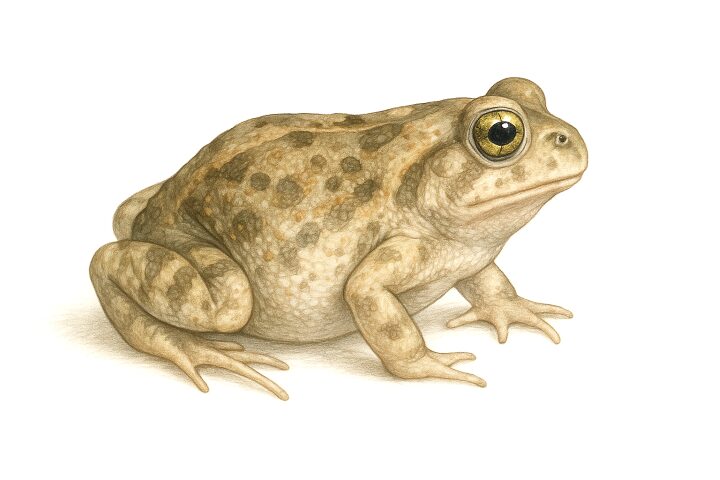
If you’re ever out in the grasslands after a summer rain and hear a strange honking noise coming from a muddy puddle, chances are you’ve stumbled upon the Plains Spadefoot. This quirky little amphibian is built for the prairie life — tough, efficient, and full of surprises. It’s named for the hard, shovel-like spade on each hind foot that helps it dig down into the soil and avoid the harsh temperatures of the plains.
What really sets the Plains Spadefoot apart is its ability to survive in some seriously dry, unpredictable environments. It spends most of its life underground and can spring into action in just hours after a heavy rain — breeding, laying eggs, and zipping through its life cycle before the water dries up.
Size & Physical Appearance
Plains Spadefoots are on the smaller side, usually measuring 1.5 to 2.5 inches in length. Their bodies are stout and slightly flattened, with relatively short legs.
Color-wise, they can vary quite a bit, but most are some shade of gray, brown, or olive green with irregular darker blotches on the back. Their skin is warty but less bumpy than a true toad’s.
One of their coolest features is their prominent bulging eyes with vertical, cat-like pupils — a helpful trait for spotting them in the field. Males are usually smaller and may have darker throats during breeding season, while females are often larger and more robust.
Habitat and Range
This spadefoot is a specialist of wide-open spaces. You’ll find it in dry grasslands, sagebrush flats, shortgrass prairies, and even open agricultural fields. It avoids heavily forested areas and prefers places where the soil is loose enough to dig into.
They’re found in the central and western United States, with a range that runs from southern Alberta and Montana down through eastern Colorado, New Mexico, Texas, and into parts of northern Mexico. States like Nebraska, Kansas, Oklahoma, and the Dakotas are all prime spadefoot country. They’re usually seen at low to mid elevations, though they can be found up to around 6,000 feet.
Diet
The Plains Spadefoot is a voracious insect-eater, especially when it emerges during breeding season. It feeds on a variety of small invertebrates, including:
- Beetles
- Crickets
- Moths
- Ants
- Spiders
Tadpoles are even more impressive — they can develop into cannibalistic morphs under crowded conditions, eating other tadpoles or even their siblings to gain a speed boost in growth. It’s a survival strategy in temporary water where time is everything.
Lifespan
In the wild, Plains Spadefoots may live up to 10 years, although many don’t make it that long due to predators or droughts. In captivity, with the right care, they can live a bit longer, but they’re not commonly kept as pets.
Identification Tips
Distinguishing the Plains Spadefoot from other spadefoots or toads can be tricky if you don’t know what to look for, but these traits can help:
- Vertical pupils: A defining feature not found in true toads (which have round horizontal pupils).
- Shovel-shaped spade: Located on the underside of each hind foot — it’s black and wedge-shaped, perfect for digging.
- Distinct “boss” between the eyes: The skin between the eyes is raised into a small bump or swelling — unusual among amphibians.
- Less warty than true toads: While it seems a little bumpy, its skin is smoother overall.
Compared to the similar Great Basin Spadefoot or Western Spadefoot, the Plains Spadefoot has more pronounced blotching and a more arid-range preference.
Fun Fact
Plains Spadefoots are master hibernators. During dry or cold periods, they can burrow up to 3 feet underground and go into a state of dormancy for months — even up to a year if conditions aren’t right. Some people call them “desert frogs in disguise” because of how well they thrive in places you wouldn’t expect to find amphibians.
Whether you’re exploring prairie potholes in Nebraska or flipping logs in eastern Colorado, keep an eye (and ear) out for the Plains Spadefoot. They’re quiet for most of the year, but when the rain falls, they come alive — honking, hopping, and carrying out their short but impressive amphibian missions.