
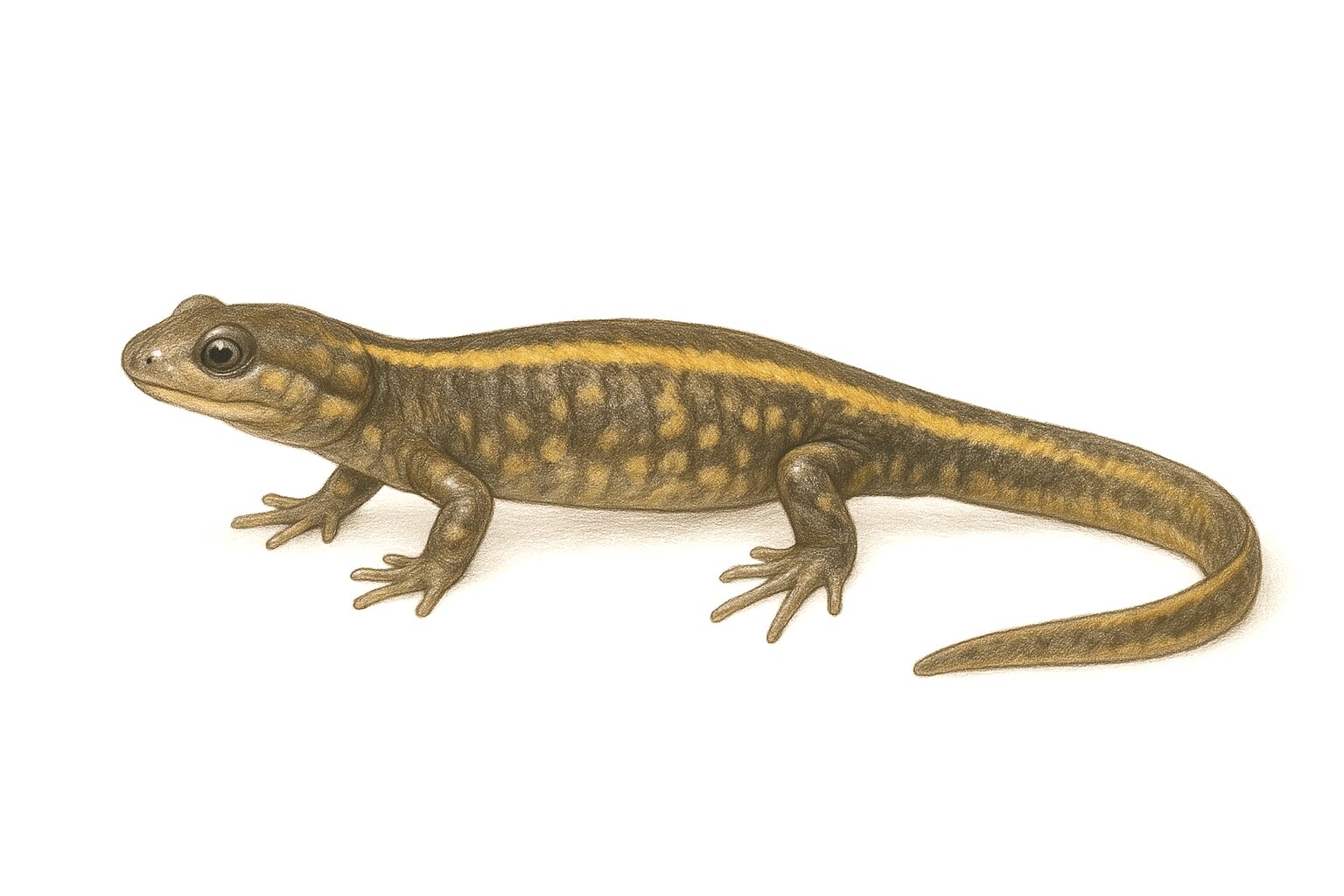
The Long-toed Salamander is a small, secretive amphibian that’s pretty easy to overlook — unless you know what to watch for. As the name suggests, one of its toes is unusually long, which sets it apart from just about any other salamander in North America. It’s a cold-loving species that thrives in higher elevations and cooler climates, making it a bit of a mountain dweller. If you enjoy hiking through forested trails in the Pacific Northwest or the northern Rockies, there’s a good chance you’re sharing the woods with this elusive amphibian.
Size & Physical Appearance
Adult Long-toed Salamanders usually measure between 4 to 6 inches long (10 to 15 cm), including the tail. Their most distinctive feature? The long fourth toe on their hind feet, especially compared to other salamanders.
Their body coloration varies depending on the population and location, but most have a dark brown, olive, or black back marked with a prominent yellow or greenish stripe running from head to tail. Some individuals may also have lighter blotches or flecks along their sides.
Juveniles look like miniature versions of the adults, though their colors tend to be more muted. Males and females look very similar, but during the breeding season, males may develop slightly swollen vents and longer tails used for courtship.
Habitat and Range
The Long-toed Salamander has a broad range in western North America, from southeastern Alaska and British Columbia down through Washington, Oregon, Idaho, western Montana, and into northern California and Nevada.
It prefers moist, forested habitats, often near ponds, lakes, or slow-moving streams. You’ll also find it in meadows and grasslands near water sources. During the dry summer months, it spends most of its time underground or under cover like logs, rocks, or leaf litter.
This species is often associated with higher elevations, from lowland forests up into mountainous areas near the treeline.
Diet
Long-toed Salamanders are opportunistic predators. They feed mostly on small invertebrates such as:
- Insects
- Spiders
- Worms
- Slugs
Larvae, which live in water, eat aquatic insects, tiny crustaceans, and even each other if food is scarce — yep, they can be cannibalistic under pressure.
Lifespan
In the wild, Long-toed Salamanders are believed to live around 6 to 10 years. In captivity, they may live a bit longer with the right conditions, but this species isn’t commonly kept as a pet due to its shy nature and specific habitat needs.
Identification Tips
The Long-toed Salamander is sometimes confused with other dark-bodied salamanders in the western U.S., like the Northwestern Salamander (Ambystoma gracile) or Tiger Salamander (Ambystoma tigrinum). Here’s how to tell them apart:
- Longtoe clue: That extra-long fourth toe on the hind foot is a giveaway. No other U.S. salamander has this feature.
- Stripe pattern: The yellow stripe running the length of the back is often broken or irregular, which differs from the more consistent striping in some relatives.
- Smaller size: They’re much smaller than Tiger Salamanders, which can grow over 10 inches long.
If you’re trying to ID a salamander you found in the Northwest, check the toe length, size, and that snake-like stripe on its back.
Fun Fact
Long-toed Salamanders can regrow parts of their limbs and even parts of their tail if injured — just like some other salamanders. But what’s especially cool is that during the breeding season, they migrate en masse to ponds across snowy terrain, often while there’s still ice along the edges. They’re some of the earliest amphibians to breed each year, taking advantage of temporary pools before predators arrive.
So if you’re out for a hike in late winter or early spring in a moist forest or alpine meadow, watch your step — you might just spot one of nature’s quietest (and quirkiest) survivors skittering across the path.