
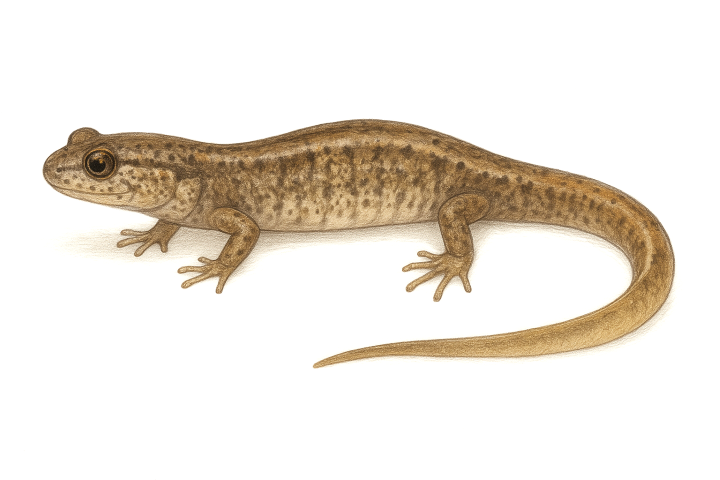
If you find yourself near a cool, clear stream in the Florida Panhandle, you might be lucky enough to spot the Apalachicola Dusky Salamander. This little amphibian is secretive and low-key, but it plays an important role in its forest ecosystem. As one of the lesser-known dusky salamanders, it’s a local treasure with a limited range and a lot of charm.
Size & Physical Appearance
The Apalachicola Dusky Salamander is on the small side. Adults usually measure between 2.5 to 4 inches in total length, including the tail.
Their coloring is earthy and subtle—typically shades of brown, gray, or olive with darker mottling or blotches along the back and sides. Look closely and you might notice a faint line or lighter stripe running down the back, although this can sometimes be hard to see. The belly is usually lighter, often a grayish or pale color.
Males and females look pretty similar, though males might have slightly more swollen cloacal areas during breeding season. Juveniles can be brighter with more pronounced patterning, which fades as they age.
Habitat and Range
This species has a very restricted range. It’s found almost entirely in the Apalachicola River drainage in the Florida Panhandle, including parts of adjacent Georgia and Alabama. Because it’s so localized, the Apalachicola Dusky Salamander is considered a range-restricted endemic.
It loves moist, forested environments—think steep ravines, seeps, and small streams where the soil stays damp and cool. You’ll usually find them under rocks, logs, or leaf litter near running water. They can be found at various elevations but are most common in low to moderate elevations where moisture is consistent.
Diet
Like many small salamanders, this species is a nocturnal predator of tiny invertebrates. Their menu includes:
- Small insects like beetles and flies
- Springtails
- Worms
- Spiders and mites
Because they’re not picky, they’ll go after almost anything that fits in their mouths and moves slowly enough to catch. In moist conditions, they can be quite active after dark, quietly hunting across the forest floor.
Lifespan
Out in the wild, Apalachicola Dusky Salamanders can live for 5 to 10 years, though exact numbers are a bit hard to pin down due to their secretive nature. In captivity, where conditions are controlled and predators are absent, they might live a bit longer—but this isn’t a species commonly kept in collections.
Identification Tips
Dusky salamanders can be tough to tell apart, especially since several species overlap in parts of their range. Here are a few ways to identify the Apalachicola Dusky Salamander:
- Tail shape: Like others in the Desmognathus genus, this species has a tail that’s compressed from side to side—it’s not rounded.
- Hind legs: The rear legs are noticeably larger than the front legs, a classic trait of dusky salamanders.
- Mouth and head: The head is relatively broad, with a slight jaw muscle bulge (more prominent in males).
- Location: If you’re in the Apalachicola River area, it’s a strong clue you’re looking at this species.
They can be confused with the Southern Dusky Salamander (Desmognathus auriculatus) or the Spotted Dusky Salamander (Desmognathus conanti), but fine-scale differences in genetics and coloration separate them. If you’re unsure, location is one of the best hints.
Fun Fact
The Apalachicola Dusky Salamander can drop its tail as a defense mechanism—something called autotomy. If a predator grabs it, the salamander will shed the tail and make a quick escape, leaving the tail behind twitching to distract the attacker. The tail eventually grows back, but it’s never quite the same.
Wrapping Up
The Apalachicola Dusky Salamander is a great example of how specialized and local amphibians can be. It’s not flashy or famous, but it plays a vital role in its watery woodland world. For nature lovers exploring the Florida Panhandle’s forests, it’s one of those hidden gems worth knowing.
If you’re out hiking in the right spot, take a quiet moment by a stream and gently peek under some rocks or leaf litter (just remember to put everything back where you found it!). You might just meet one of these shy little forest dwellers.