
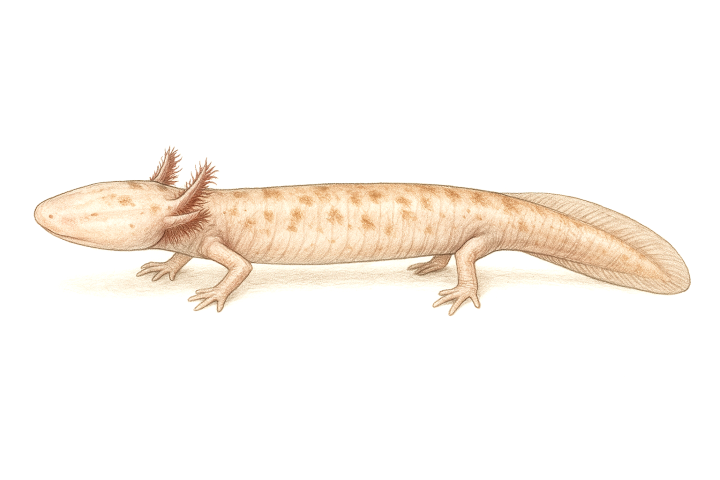
The Austin Blind Salamander is one of those species that feels like it belongs in a sci-fi movie. It lives its whole life underground in complete darkness — and as a result, it’s totally blind. Native only to a small area in Texas, this rare salamander is a fascinating glimpse into what happens when life adapts to a lightless world. With its pale body, feathery gills, and elusive nature, it’s one of the most unique amphibians in the United States.
Size & Physical Appearance
This salamander stays fairly small, typically growing to about 1.8 to 2.7 inches long. What really stands out is its pale, almost translucent skin, which can range from pinkish-white to light gray. Since it lives in darkness, it has no functional eyes — just two dark spots where eyes would normally be.
It also sports external gills that look like red or pink feathery plumes on either side of its head. These help it breathe underwater, since it never comes to the surface. Males and females look quite similar, though during mating season, males might be a bit more slender and have slightly enlarged cloacal glands.
Habitat and Range
The Austin Blind Salamander is truly a Texan native. It’s only found in central Texas, specifically in the Edwards Aquifer region around Austin. More precisely, it lives in underwater caves and springs fed by this aquifer — most notably near Spring Lake and Barton Springs.
This species spends most of its life underground in the aquifer, coming close to surface-level spring outlets only occasionally. It’s strictly aquatic and does not venture onto land, even as an adult.
Diet
Because it’s nearly impossible to study directly in the wild, biologists believe the Austin Blind Salamander feeds on tiny creatures that also live in the aquifer. That includes small crustaceans, insect larvae, and other invertebrates floating in the water or crawling along the floor of the springs.
One of the interesting challenges for this salamander is hunting without sight. It relies on motion detection and chemical cues in the water to find its prey.
Lifespan
Exact lifespan data is limited, but similar species of Eurycea salamanders can live for at least 8 to 10 years in the wild. In captivity, under ideal conditions, they might live slightly longer — though this species is rarely kept outside of research programs due to its endangered status and sensitive needs.
Identification Tips
If you’re lucky enough to see an Austin Blind Salamander (it’s rare!), here’s how to tell it apart from others like the Barton Springs Salamander (Eurycea sosorum):
- Eyes: The Austin Blind Salamander has , just dark eye spots. Barton Springs Salamanders have small but developed eyes.
- Color: Austin Blind Salamanders are more pale or pinkish-white, compared to the darker gray or brown coloration of Barton Springs Salamanders.
- Habitat depth: The Austin Blind Salamander lives deeper in the aquifer system. The Barton Springs Salamander is often closer to the surface and more visible in the open water of the springs.
Fun Fact
This salamander is so well adapted to life in the dark that it completely gave up its eyesight. Scientists believe the energy it would have used to grow and maintain eyes is now redirected to other senses, like touch and smell. It’s like evolution said, “Why bother with eyes if you’ll never use them?”
Also worth noting — the Austin Blind Salamander was only officially described in 2001, making it a fairly recent discovery in the amphibian world.
In Summary
The Austin Blind Salamander is one of those hidden gems of the amphibian world — literally. It’s unique, rare, and completely specialized for a life out of sight. If you ever find yourself visiting Barton Springs or exploring central Texas’s spring-fed waters, remember there’s an entire hidden world just beneath your feet — and this unusual little salamander is part of it.