
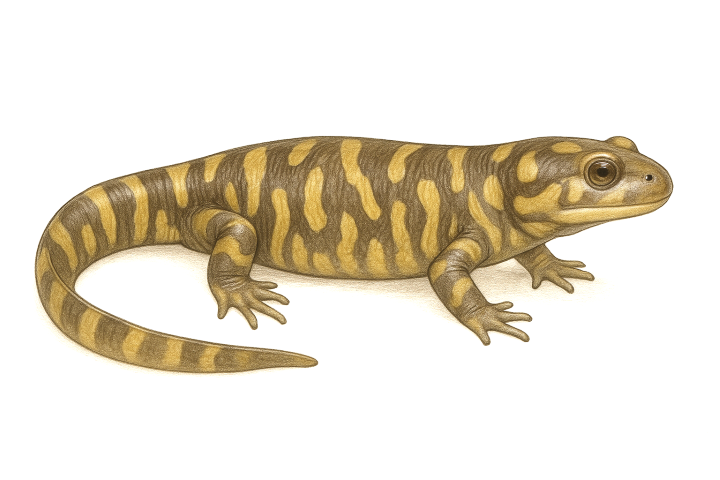
One of the largest land-dwelling salamanders in North America, the Barred Tiger Salamander is a striking amphibian with bold patterns and a fascinating life story. Known for its secretive underground lifestyle and bold black-and-yellow markings, this salamander might just be one of the coolest critters you’ll rarely see in the wild. Despite how elusive they are, they play an important role in the ecosystems they live in — and have a few surprises up their sleeves.
Size & Physical Appearance
Barred Tiger Salamanders are big, chunky salamanders. Adults typically grow between 6 to 8.5 inches long, though some individuals can reach up to 10 inches.
They have stout bodies, a broad, flat head, and noticeably large tails. Their coloring is usually made up of irregular yellow or olive bars or blotches against a dark brown or black background, which gives them that distinctive “tiger-striped” look. That pattern can vary quite a bit, though — some individuals have fewer or fainter bars, while others are dramatically marked.
There’s usually not a huge difference in appearance between males and females, although males may be slightly larger and have longer tails during breeding season. Juveniles (often called larvae) look completely different — they’re aquatic, with fluffy gills sticking out the sides of their heads.
Habitat and Range
Barred Tiger Salamanders are adaptable and widespread throughout the central and western United States. You’ll find them in grasslands, prairie potholes, savannas, forests, deserts, and agricultural areas. Despite their name, they don’t need forested habitat — they’re just as happy in open fields if there’s water nearby for breeding.
They’re found in states like Texas, Colorado, Kansas, Nebraska, Oklahoma, Wyoming, Montana, North Dakota, South Dakota, and parts of surrounding states. Some populations also move into southern parts of Canada and northern Mexico.
These salamanders spend most of the year underground, living in burrows up to two feet deep, either dug themselves or taken over from small mammals. They come to the surface primarily during rainy nights or in the spring when it’s time to breed.
Diet
Barred Tiger Salamanders are opportunistic predators. That means they’ll eat just about anything small enough to fit in their mouths — and they’re not picky eaters.
Their diet includes:
- Worms
- Insects
- Spiders
- Slugs
- Small frogs
- Other amphibians (sometimes even other salamanders)
Larger individuals have even been known to eat small mice or nestling birds. In their larval stage, they feed on tiny aquatic creatures like insect larvae and zooplankton.
Lifespan
In the wild, Barred Tiger Salamanders can live around 10 to 15 years, which is pretty long for an amphibian. In captivity, with proper care, they might live even longer — some reportedly have made it to 20 years.
Identification Tips
Because they spend so much time underground, spotting one in the wild is a bit of a lucky break. But if you think you’ve got a Barred Tiger Salamander on your hands, here’s how to tell:
- Look for the bold yellow or olive bars on a dark body (not spots).
- They’re stout and thick-bodied — more “chunky” than sleek.
- They’re larger than most salamanders people might encounter.
- If it’s a larva in a pond, it’ll have feathery external gills but will look much bigger and bulkier than a frog tadpole or smaller newt larvae.
Don’t confuse them with the Eastern Tiger Salamander (Ambystoma tigrinum), which looks similar but has a different range (more in the Eastern U.S.) and often more spotted than barred markings.
Fun Fact
Some Barred Tiger Salamanders never leave the water. In certain environments, their larvae don’t always go through full metamorphosis into land-dwelling adults and instead mature while keeping their gills and aquatic traits. This condition is called neoteny, and it’s a super cool example of how amphibians can adapt to local conditions. These gilled adults can even reproduce without ever stepping onto land!
Wrap-up
The Barred Tiger Salamander might not be the first amphibian that comes to mind, but it’s definitely one of the most fascinating. They’re big eaters, quiet neighbors, and come with an unusual ability to stay young if the environment calls for it.
If you’re lucky enough to spot one during a rainy spring night, take a good look — but remember to admire from a distance. These underground giants are a reminder of how much life is happening just below our feet.