
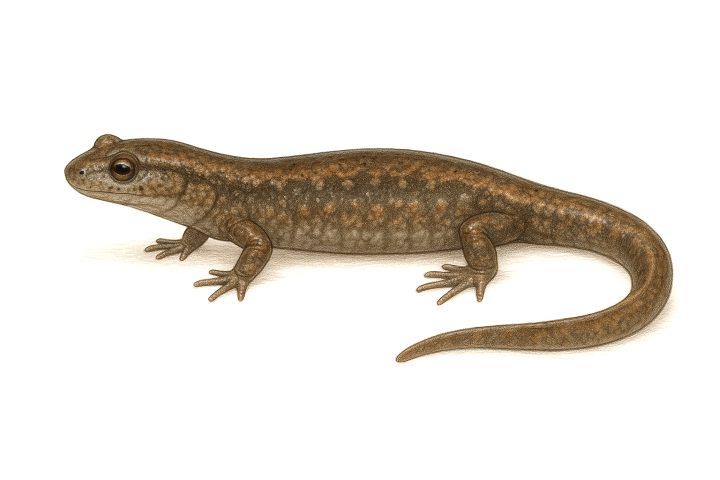
The Black Mountain Salamander is one of those quiet forest dwellers that you might miss if you’re not looking closely. Found mostly in the cool, clear streams of the Appalachian Mountains, this amphibian tends to keep a low profile. But don’t let its secretive nature fool you — it’s an important part of its ecosystem and has a few surprises up its sleeve.
Size & Physical Appearance
Black Mountain Salamanders are considered medium to large for stream salamanders. Adults typically measure between 3.5 and 6 inches long, nose to tail. Their coloring is usually a mix of dark brown or black with subtle lighter markings, sometimes with a slightly lighter belly that can be grayish or faintly mottled. Their skin is moist and smooth, and they tend to have a chubby, robust body.
Unlike some amphibians with dramatic color differences between sexes, males and females of this species look pretty similar. Juveniles may appear slightly more speckled and have a lighter overall appearance, but many of the differences are subtle.
Habitat and Range
This salamander is strongly tied to clean, flowing water. You’ll often find it in cold mountain streams, seeps, and small creeks surrounded by forest cover. It prefers rocky, shaded areas and usually hides under logs, stones, or leaf litter near the water’s edge.
The Black Mountain Salamander is endemic to the southern Appalachian Mountains, meaning it lives only in that specific region. It’s found in parts of eastern Kentucky, western Virginia, eastern Tennessee, and southwestern West Virginia. Because of its preference for elevation, you’re more likely to encounter it above 2,000 feet.
Diet
Like many stream salamanders, this species is insectivorous. It feeds on small invertebrates such as:
- Aquatic insect larvae
- Small crustaceans
- Worms
- Snails
Occasionally, they’ll venture onto land at night to hunt. Their excellent night vision and stealthy movement make them effective ambush predators of the tiny world.
Lifespan
In the wild, Black Mountain Salamanders are thought to live around 5 to 10 years, though exact data is limited due to their secretive lifestyles. In captivity, if kept under the right conditions (which is not easy), they may live slightly longer — but these are not commonly kept pets, and their specific habitat needs make them more suited to the wild.
Identification Tips
This species can be tricky to distinguish from other dusky salamanders — especially Desmognathus fuscus (Northern Dusky) and Desmognathus monticola (Seal Salamander).
- Robust body: The Black Mountain Salamander is chunky and sturdy, more so than many of its relatives.
- Tail shape: Its tail is moderately keeled (somewhat flattened from side to side), useful for swimming and a clue for ID.
- Less prominent pattern: Unlike the bold “seal-like” markings of the Seal Salamander, Black Mountain Salamanders tend to have a darker, duller pattern with faint spotting or no spots at all.
- Geography helps: Since it has a limited range, knowing you’re in the central or southern Appalachians can help narrow it down.
Fun Fact
Here’s something cool: Black Mountain Salamanders lay their eggs underwater, attaching them to the underside of rocks in fast-moving streams. Unlike many salamanders, their larvae stay in the water for a while and have gills — kind of like miniature aquatic dragons!
This aquatic nesting behavior requires exceptionally clean, oxygen-rich water, which is why the species is so sensitive to pollution or silt runoff from disturbances like logging or mining.
If you’re hiking through the Appalachians and stumble across a cold, rocky stream, take a moment to peer under a rock (gently, and always return it carefully). You just might catch a glimpse of this shy mountain resident.