
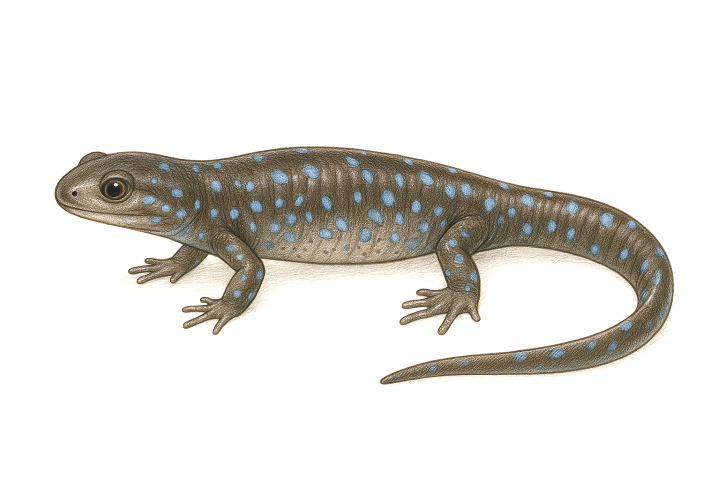
The Blue-spotted Salamander is one of those amphibians that’s easy to fall in love with. Small, secretive, and quite beautiful, it’s usually tucked away under logs or leaf litter, so spotting one feels like finding a hidden gem in the woods. What makes it really stand out? You guessed it: those bright blue spots scattered across its dark body. It almost looks like someone flicked a paintbrush at it. And while it’s not the easiest salamander to find, its shy nature only adds to its charm—like a little forest treasure hiding beneath your feet.
Size & Physical Appearance
Blue-spotted Salamanders are on the smaller side. Adults typically measure between 3 to 5.5 inches long, including their smooth, narrow tails.
Their bodies are usually dark bluish-black or gray-black with a scattering of light blue to bluish-white spots along their sides, legs, and tails. The blue is more prominent in some individuals than others—some really pop, while others might look more speckled.
There’s not a huge visual difference between males and females, though during breeding season, males tend to have slightly longer tails and more swollen cloacal areas (that’s the opening they use for both reproduction and waste).
Juveniles pretty much resemble adults, just in smaller form, though sometimes their markings are a bit brighter at first.
Habitat and Range
These salamanders are mostly found in the Northeastern and Upper Midwest parts of the U.S., including states like Michigan, Wisconsin, Minnesota, New York, Vermont, New Hampshire, and parts of Illinois, Ohio, and Indiana. Their range also extends into southern parts of Canada.
They prefer moist hardwood forests, but can also be found in mixed forests, especially where the soil stays damp. They like areas with lots of leaf litter, rotting logs, and other natural cover. They’re not big fans of dry conditions, so they tend to stay in areas where the ground stays moist most of the year.
During the spring breeding season, they migrate—often overnight and during rainstorms—to temporary vernal pools, which are seasonal ponds perfect for laying eggs without fish predators.
Diet
In the wild, Blue-spotted Salamanders aren’t picky eaters. They’re carnivores and mostly eat small invertebrates such as:
- Earthworms
- Insects (and insect larvae)
- Spiders
- Slugs and snails
- Small crustaceans in wetland areas
They usually hunt at night, using their sticky tongues to catch prey quickly. If you’re lucky enough to see one hunting, it’s kind of like watching a little amphibian ninja.
Lifespan
In the wild, Blue-spotted Salamanders can live up to 10 years, although most probably don’t make it quite that long due to predators and environmental threats. In captivity, where threats are reduced (and if they’re well cared for), they can reach the same or sometimes slightly longer lifespans.
Identification Tips
There are a few salamanders that look similar, but here’s how to tell the Blue-spotted apart:
- Small-mouthed Salamander: Similar size, but usually darker with fewer or no blue spots. Found more in the south-central U.S.
- Jefferson Salamander: Larger and more slender. Mostly has silvery or bluish flecking (more scattered than spotted), especially on the limbs. These two species hybridize often, making ID tricky in overlap zones.
- Tiger Salamander: Much bigger, with yellow or olive-colored blotches. Much chunkier overall.
One big clue is the environment. If you’re in northern wooded areas near vernal pools in early spring, and you see a small, dark salamander with bright blue spotting—this might be your guy.
Fun Fact
The Blue-spotted Salamander is part of a complex hybrid group involving other Ambystoma species like the Jefferson Salamander. In some areas, individuals aren’t pure species at all but are actually all-female hybrids that reproduce through a weird method called kleptogenesis. Basically, they “borrow” sperm from males of related species to activate egg development—some crazy amphibian science magic!
Wrapping It Up
The Blue-spotted Salamander might not be famous, but it’s a fascinating little amphibian that plays an important role in forest ecosystems. Whether you’re a student doing a project or a nature lover hoping to spot one on your next hike, keep your eyes out near vernal pools in the spring or under logs and leaves all year round.
Just remember—if you do find one, observe with care and don’t disturb its habitat. Salamanders breathe through their skin, and oils from human hands can harm them. Admire, learn, and let them be the forest’s quiet little residents.
Happy herping!