
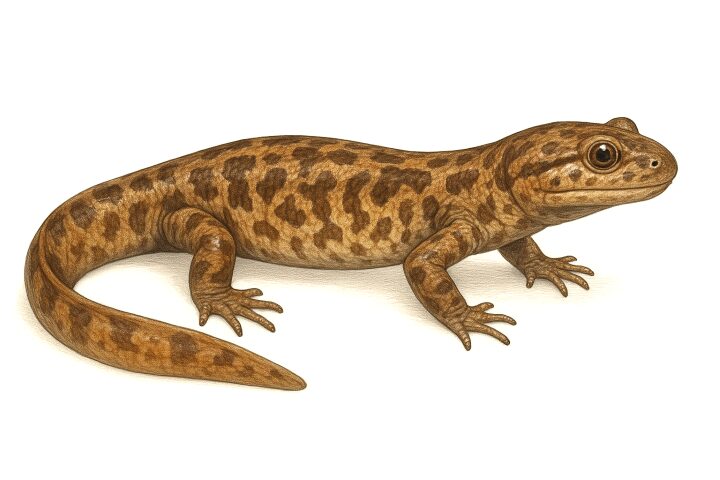
The California Giant Salamander lives up to its name — it’s one of the largest terrestrial salamanders in North America. Found mostly in the misty forests of Northern California, this chunky amphibian is known for both its size and its secretive lifestyle. It’s also one of the few salamanders that can make vocal sounds — almost like a bark — which is pretty wild for this group of usually silent animals.
Size & Physical Appearance
California Giant Salamanders are impressively big for a salamander. Adults usually measure around 6 to 12 inches long, but some can reach up to 14 inches — that’s over a foot long.
They have a thick, muscular body and a broad head with strong jaws. Their skin is usually a mottled brown and tan or purplish-bronze, which helps them blend in with the forest floor. They often have a marbled or reticulated pattern, almost like a maze.
Juveniles and aquatic adults tend to look a bit different — they’re usually lighter in color and have visible external gills, especially when they are still larval or neotenic (more on that below).
Males and females look pretty similar, although during breeding season, males may have slightly longer toe tips and swollen cloacal glands, but the differences aren’t dramatic to the casual observer.
Habitat and Range
These salamanders are native to northern California, mostly in the coastal ranges from Mendocino County down to around Santa Cruz County. They’re almost always found in damp, shady, forested regions — especially in mature redwood and Douglas fir forests.
They need cold, clear streams or seeps to breed and for larval development. Adults live either in water or on land, depending on their life stage. On land, they take shelter under logs, rocks, or in burrows near streams. They’re found at elevations from near sea level up to about 5,000 feet.
Fun tip for hikers: if you’re exploring a redwood forest with lots of running water nearby, you’re in California Giant Salamander territory.
Diet
In the wild, these salamanders are meat-eaters with a pretty broad diet. They eat things like:
- Insects
- Spiders
- Worms
- Small frogs
- Even smaller salamanders
Larger adults are big and bold enough to go after small mammals or other vertebrates if the opportunity comes along. They’ve even been known to eat fish larvae and aquatic insects while in the water.
Lifespan
In the wild, they likely live around 10 to 15 years, maybe a bit longer if they’re lucky. In captivity, they’ve been reported to live more than 20 years under the right conditions, though exact data is a little limited.
Identification Tips
The California Giant Salamander can be confused with a couple of similar species, especially if you’re up in the Pacific Northwest. Here’s how to tell them apart:
- Versus Pacific Giant Salamander (Dicamptodon tenebrosus): The Pacific species lives farther north and has a slightly different range. Genetically, they’re distinct, but visually very similar. In general, if you’re south of Mendocino County, you’re probably seeing D. ensatus.
- Versus Tiger Salamander: Tiger Salamanders are also large and robust, but they have bold yellow or cream markings on dark skin — very different from the California Giant’s marbled brown pattern.
- Versus other stream salamanders: Most other salamanders in California are much smaller and slimmer, and don’t get near the size of this species.
Also, keep in mind that some adults keep their larval features (like gills) even after they’re fully grown — this is called neoteny. Neotenic adults are completely aquatic and can be mistaken for big larvae.
Fun Fact
California Giant Salamanders are one of the few salamanders that can vocalize. When startled or handled, they can emit a soft barking or clicking sound — kind of like a little dog. It’s rare, but it’s real.
Wrap-Up
If you’re hiking through a lush, coastal redwood forest in Northern California and spot a thick, marbled salamander under a log or near a stream, you’ve probably met a California Giant Salamander. With its secretive habits, surprising size, and even the ability to bark, this species is one of the hidden gems of western forests. Just be sure to admire it gently — they’re sensitive amphibians and protected in many parts of their range.