
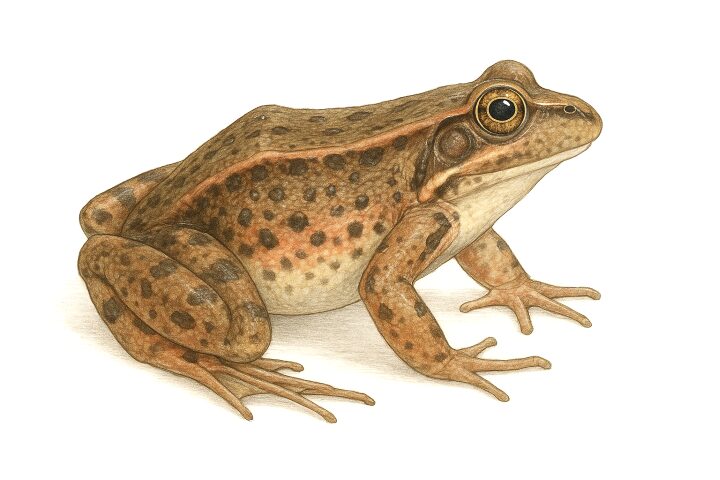
The California Red-legged Frog isn’t just another amphibian — it’s a West Coast icon. This species is actually the largest native frog in California and gained national attention as the “celebrity frog” in Mark Twain’s short story, The Celebrated Jumping Frog of Calaveras County. Once common across much of California, it’s now considered threatened, making each sighting a little more special.
Size & Physical Appearance
California Red-legged Frogs are on the larger side for frogs in the U.S., with adults typically ranging from 1.5 to 5 inches long (snout to vent). Females tend to be slightly larger than males.
They’re pretty easy to recognize thanks to their:
- Reddish coloring on the underside of the legs and belly, which gives them their name
- Olive, brown, or gray-green backs often covered in black spots
- Dorsolateral folds (those skin ridges) that run from behind the eye down the sides of the back
- Males have a swollen thumb during breeding season and more vocal sacs for calling
Juveniles are usually duller and smaller with less red in their limbs, making them a bit trickier to identify.
Habitat and Range
These frogs love places with calm, slow-moving water. You’ll find them in marshes, ponds, streams, and other freshwater wetlands — especially where aquatic vegetation and overhanging plants give them cover.
They spend most of their time near water but can move up to several miles across land to find new habitats when needed.
As the name suggests, they’re native to California, mainly in the central and coastal regions, with some populations extending into northern Baja California, Mexico. Sadly, they’ve disappeared from a lot of their historical range in the Sierra Nevada and Southern California due to habitat loss.
Diet
Red-legged frogs aren’t picky eaters. They’ll eat pretty much anything they can catch and fit in their mouths, including:
- Insects
- Spiders
- Small crustaceans
- Other frogs or tadpoles
- Even the occasional small mammal, like a mouse, if the opportunity arises
Tadpoles mostly stick to algae and organic detritus.
Lifespan
In the wild, these frogs can live around 6 to 10 years, though many don’t make it past their first year due to predators and environmental challenges. In captivity, with fewer threats, they may live a bit longer under proper care.
Identification Tips
It’s easy to confuse the California Red-legged Frog with a few other species, especially the Northern Red-legged Frog (Rana aurora) or the invasive American Bullfrog (Lithobates catesbeianus).
Here’s how to tell them apart:
- Red on the legs: True California Red-legged Frogs have distinctly red undersides on their back legs
- Voice: Their calls are weak compared to loud bullfrogs; it sounds more like a low grunting sound
- Size: They’re larger than Northern Red-legged Frogs and smaller than American Bullfrogs
- Dorsolateral folds: On red-legged frogs, the folds run the length of the back. Bullfrogs lack these folds entirely
If you’re near a wetland in California and spot a big frog with reddish legs and ridges behind the eyes, you just might be seeing this rare native species.
Fun Fact
This frog was the first amphibian listed as a federally threatened species under the Endangered Species Act. That status came in 1996, after major habitat loss and disruption from non-native species like the bullfrog dramatically reduced the population. Conservation groups and wildlife agencies have since been working to bring them back — and it’s working, slowly but surely.
Want to Help?
If you’re lucky enough to see a California Red-legged Frog, take a photo (from a distance), note the location, and report it to your local wildlife agency. Avoid handling wild frogs — their skin is sensitive and can absorb oils or chemicals from our hands. And if you garden or live near wetland areas, avoid using pesticides, which can harm both frogs and their food sources.
This frog may be a federally protected species now, but with a little help from all of us, it might just make a big comeback.