
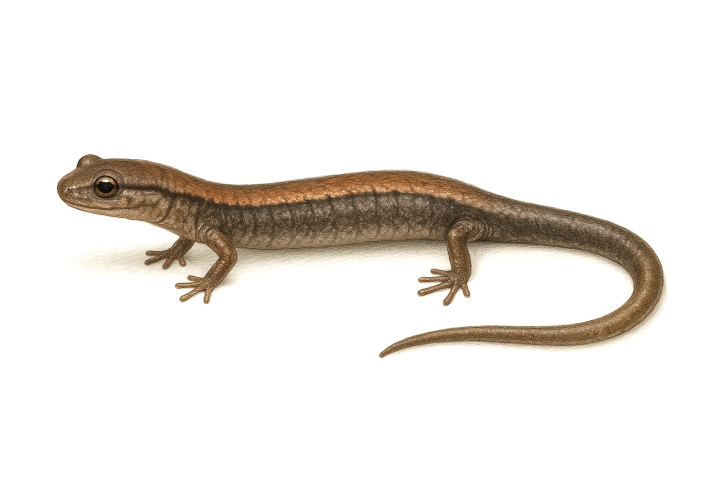
The California Slender Salamander (Batrachoseps attenuatus) is one of those critters that looks like it could wiggle away any second—and it probably could. With its pencil-thin body and tiny legs, it’s perfectly adapted for slipping between leaf litter, burrowing in soil, and navigating narrow spaces under rocks and logs. Found only on the West Coast, it’s a true California native and master of staying out of sight. If you’re into herping or just love discovering what’s hiding under a log, this salamander is a fun one to find.
Size & Physical Appearance
This salamander definitely lives up to its “slender” name. Adults usually range from about 3 to 5.5 inches long, but most of that length is tail—sometimes twice as long as their body.
Their coloring varies a bit, but they’re typically dark brown, black, or reddish with a lighter brown or coppery stripe running down their back. Look closely, and you might see tiny speckles of white or silver on the sides. Their legs are short and skinny, almost comically so, and they have four toes on each foot—which sets them apart from many other salamanders with five toes.
Juveniles look like mini versions of the adults, but they may appear a bit shinier or darker until their colors settle.
Habitat and Range
California Slender Salamanders are found only along the coastal regions of Northern and Central California, from around the Bay Area south into parts of San Luis Obispo and Monterey counties. They also show up in parts of extreme southern Oregon.
These salamanders love moist, shady environments. Think oak woodlands, coastal forests, grassy hillsides, and residential gardens with mulch or leaf litter. They’re surface-active during wet months but burrow deep underground during the dry summer, often following small soil cracks and root channels.
You’ll mostly find them at low to moderate elevations, typically below 3,000 feet.
Diet
These guys are insectivores. They eat a variety of tiny invertebrates, including:
- Springtails
- Small beetles
- Mites
- Ants
- Spiders
They hunt by using their sticky tongue to snag prey in tight spaces. It’s a great strategy for life in the leaf litter, where every crumb of soil could hide a snack.
Lifespan
In the wild, most California Slender Salamanders live for about 6 to 10 years if they avoid predators and extreme drought. In captivity, with good care, some have lived longer, but they’re not commonly kept as pets.
Identification Tips
Here’s how to tell the California Slender Salamander apart from similar species:
- Four toes on each foot: Many salamanders have five
- Very narrow body and long tail: Think spaghetti with legs
- No lungs: Like others in its family, it breathes through its skin and mouth lining
- Dry-skinned and slow-moving: Compared to lizards, which are quicker and have dry, scaly skin
Be careful not to confuse them with juvenile lizards. Unlike lizards, salamanders don’t have noticeable external ears and their skin is moist.
Fun Fact
The California Slender Salamander can shed its tail when a predator grabs it. This self-amputation (called autotomy) lets the salamander escape while the tail twitches and distracts the threat. The tail eventually grows back, although it might look a bit different than the original.
Final Thoughts
The California Slender Salamander might not be flashy, but it’s a fascinating little creature with a big role in its ecosystem. Its impressive ability to survive dry summers underground and its ultra-thin flexibility make it stand out among amphibians. If you’re exploring a California trail after a rainstorm, flip a rock or log (carefully!)—you just might spot one of these elusive, squiggly gems. Just remember to always replace any cover objects and let them be.
They may be small, but they’re a big part of what makes California’s natural world so wild and wonderful.