
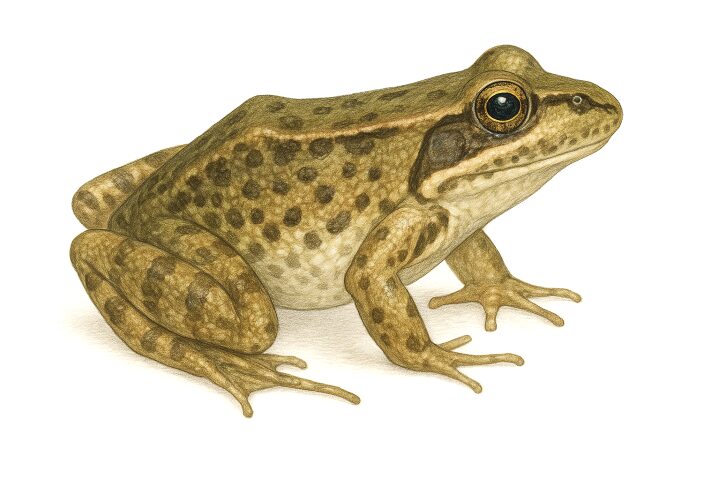
Found high in the mountains of the Pacific Northwest, the Cascades Frog lives a quiet life in some of the most beautiful backcountry you can hike into. What makes it especially interesting? For starters, this frog actually freezes solid during winter — and lives to leap another day come spring. It’s a high-altitude amphibian survivor with a superpower.
Size & Physical Appearance
Cascades Frogs are medium-sized for frogs in the western U.S., typically measuring about 2 to 3 inches long (roughly 5 to 7.5 centimeters). Their color can vary quite a bit depending on their surroundings, but most have a mottled brown, olive, or grayish-green body. Some individuals have dark spots or flecks across their backs.
Their skin texture is somewhat bumpy, and they often have a faint light stripe running along the upper jaw. Males are usually smaller and slimmer than females, especially during breeding season.
Young frogs (called metamorphs) look like miniature adults, but they often appear more uniformly colored and are significantly smaller — less than an inch long when they first leave the water.
Habitat and Range
As their name suggests, Cascades Frogs are mostly found in the Cascade Range of the Pacific Northwest. They live in parts of Washington, Oregon, and northern California, usually at elevations between 3,000 and 7,000 feet.
This species loves cold, clean water and tends to stick near alpine and subalpine ponds, lakes, and marshes. You’re unlikely to find them in lowland areas. They rely on snowmelt pools and slow-moving streams — often in remote, hard-to-reach places.
Because of their specific habitat needs, they often serve as indicators of ecosystem health. If Cascades Frogs are around, the water and habitat are probably in pretty good shape.
Diet
Cascades Frogs are opportunistic feeders, meaning they’ll eat whatever small prey they can catch. Their diet includes:
- Insects (like beetles, flies, and ants)
- Spiders
- Worms
- Occasionally smaller frogs or tadpoles
As tadpoles, they feed mostly on algae and small organic debris. Once they become adults, they switch to a carnivorous diet.
Lifespan
In the wild, Cascades Frogs can live up to 5 to 8 years, although many don’t survive that long due to predators and harsh conditions. Lifespan in captivity isn’t well-documented, mostly because this species isn’t commonly kept or bred in captivity due to its specialized needs.
Identification Tips
At a glance, Cascades Frogs can look like some other native species, but there are a few key traits to keep in mind:
- They do not have the bold dorsal folds (raised lines along the back) seen on Oregon Spotted Frogs or Northern Red-legged Frogs.
- Their bumpy skin and mottled coloring help distinguish them from smoother-skinned frogs like the Pacific Treefrog.
- They often have a subdued, earthy tone and lack the vivid redness or greenish brightness of some lookalikes.
- If you’re in the high mountains and spot a frog near a snowmelt pool — it’s probably a Cascades Frog.
It helps to know what species are likely found at certain elevations. Treefrogs, for example, are rarely seen above 6,000 feet, but Cascades Frogs thrive there.
Fun Fact
Here’s a wild one: during the winter, Cascades Frogs go into a frozen state. Their bodies literally freeze — heart stops, breathing slows to nearly zero — and they stay that way for weeks or even months. When spring returns and things thaw out, they “wake up” and hop right back into life. It’s one of the coolest survival tricks in the amphibian world.
In Closing
The Cascades Frog is a quiet mountain resident that most people never see unless they venture into alpine meadows and backcountry lakes. But this little frog plays a big role in its ecosystem and adds to the biodiversity of the Pacific Northwest.
If you’re hiking in places like Mount Rainier or the Three Sisters Wilderness, keep an eye out. Just remember to look — not touch — and appreciate this frozen-leaping, high-altitude marvel of a frog.