
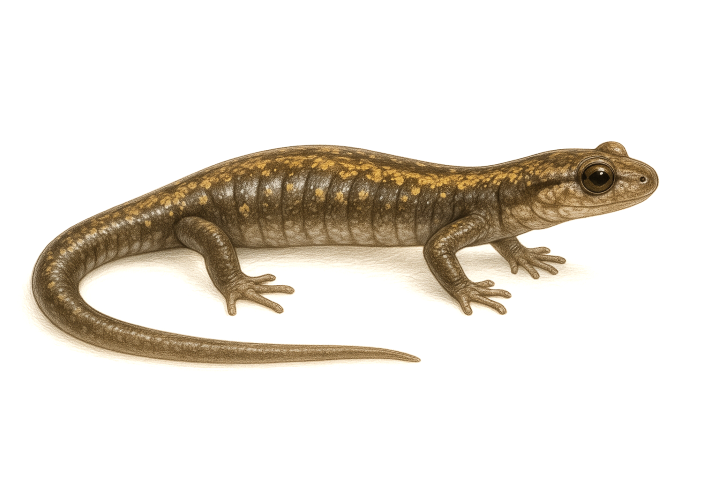
The Cheat Mountain Salamander is a small, secretive amphibian that’s both rare and remarkable. Found only in a tiny slice of the Appalachian Mountains in West Virginia, it’s what’s called an endemic species—meaning it lives nowhere else on Earth. Its limited range and sensitivity to habitat changes have made it a symbol of high-elevation forest conservation. If you’re lucky enough to spot one, you’re seeing something truly special.
Size & Physical Appearance
Cheat Mountain Salamanders are on the smaller side, usually ranging from 2.5 to 4.5 inches long, including the tail. They have a dark brown or black body with a distinct, narrow brassy to golden stripe running down the back, which can vary in brightness and width. Tiny white or silver speckles often decorate the sides and belly.
Males and females look pretty similar, though males may have slightly longer tails and broader heads during breeding season. Juveniles often have less vivid coloring and may lack the dorsal stripe entirely when they’re very young.
Habitat and Range
This salamander has one of the most restricted ranges of any amphibian in the U.S. It’s found only in the high-elevation forests of West Virginia, particularly in the Allegheny Mountains and namesake Cheat Mountain. It sticks to elevations above 3,000 feet, preferring cool, moist spruce forests or mixed hardwood stands with plenty of leaf litter, moss, and decaying logs.
Because they breathe through their skin, Cheat Mountain Salamanders rely on wet, shaded microhabitats—dry spells or habitat changes can cause populations to decline quickly.
Diet
These little salamanders are nocturnal hunters, feeding mainly on small invertebrates. Their diet includes:
- Ants
- Mites
- Springtails
- Beetles
- Small worms and insect larvae
It’s a simple but important role—keeping the forest floor insect population in check. Interestingly, they depend on leaf litter not just for cover but also for their food source.
Lifespan
In the wild, Cheat Mountain Salamanders can live for 8 to 10 years, and possibly longer under optimal conditions. In captivity, their lifespan isn’t well-documented because they’re rarely kept or bred in zoos due to their endangered status and specialized habitat needs.
Identification Tips
Telling Cheat Mountain Salamanders apart from their close relatives can be tricky, but here are some helpful pointers:
- Look for the narrow golden-brassy stripe running along the back.
- They’re smaller and darker than some other woodland salamanders, like the Eastern Red-backed Salamander (Plethodon cinereus), which has a more reddish stripe and a broader range.
- They may resemble younger individuals of other species, so location is key—finding one above 3,000 feet in West Virginia is a good clue you’re seeing a Cheat Mountain Salamander.
Fun Fact
Did you know the Cheat Mountain Salamander was one of the first amphibians in the U.S. to be federally listed as “threatened” under the Endangered Species Act? It was listed in 1989 due to its tiny range and declining habitat, mostly from logging and climate change. That listing helped protect portions of its habitat and raise awareness for patchy high-elevation ecosystems.
Final Thought
The Cheat Mountain Salamander is a great example of how even small creatures can have a big ecological story. Its survival is closely tied to the health of Appalachian mountain forests, making it a quiet but powerful reminder of why protected natural spaces matter. If you’re hiking in the right part of West Virginia on a cool, damp evening, keep your eyes peeled—you might just catch a glimpse of this mountain gem.