
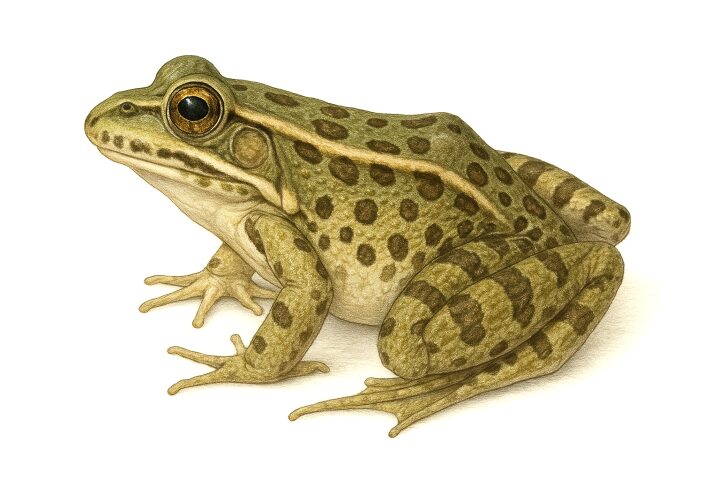
The Chiricahua Leopard Frog is like the underdog of the frog world — a rare and remarkable species fighting for survival in the American Southwest. It’s named after the Chiricahua Mountains in southeastern Arizona, one of the few strongholds where it still survives today. With its striking green coloring and unusual calls, it stands out as a unique and charismatic amphibian that’s become a symbol of conservation in desert regions.
Size & Physical Appearance
Chiricahua Leopard Frogs are medium-sized amphibians, typically growing between 2.1 to 4.3 inches (5.3 to 10.9 cm) in length.
They usually have a green to greenish-brown back covered in dark spots, similar to a leopard’s spots — hence the name. Their bellies are pale or white, sometimes with yellow coloring along the legs. A key feature is the light-colored fold of skin running along either side of their backs (called dorsolateral folds).
Males tend to be slightly smaller than females and may have darker throats. Juveniles look like smaller versions of adults but might have less defined markings.
Habitat and Range
Chiricahua Leopard Frogs are pretty picky about where they live. They prefer still or slow-moving aquatic habitats like spring-fed ponds, stock tanks, and streams — especially those with permanent water.
They’re found in parts of Arizona, New Mexico, and a small area of northern Mexico, typically at elevations between 3,300 and 8,500 feet. Unfortunately, because of habitat loss, invasive species, and disease, their range has shrunk over the years, and many populations are now isolated.
Diet
These frogs are not picky eaters. They’re opportunistic feeders and will eat almost anything they can fit in their mouths, including:
- Insects (like beetles and ants)
- Spiders
- Worms
- Even smaller frogs or tadpoles at times
As tadpoles, they graze on algae and plant matter.
Lifespan
In the wild, Chiricahua Leopard Frogs live about 3 to 5 years, though this can vary depending on environmental conditions. In captivity, with proper care, they may live a bit longer.
Identification Tips
Telling Chiricahua Leopard Frogs apart from other leopard frog species can be a bit tricky, especially since several species overlap in range and look similar.
Here are a few tips:
- Look for the light-colored, raised dorsolateral folds that stop short before reaching the groin.
- They often have a green upper body with large, distinct dark spots — more spaced out compared to some cousins.
- The inner thighs are usually yellow or orange, which helps distinguish them from some other leopard frogs.
- The call sounds like snoring or a clucking chicken — quite different from the traditional “ribbit” you might expect.
They can sometimes be confused with the Plains Leopard Frog or Lowland Leopard Frog, but the combination of spots, thigh color, and call usually helps narrow it down.
Fun Fact
The Chiricahua Leopard Frog was once considered extinct in parts of its range — but thanks to recovery efforts, captive breeding, and habitat restoration, some populations have made a comeback. In some areas, ranchers have even helped conserve the species by maintaining cattle tanks that serve as key frog habitats!
These frogs are also one of a few amphibians that can be heard calling even when it’s not the breeding season, especially after rains — so if you’re out hiking near a desert spring and hear what sounds like a snoring noise, keep an eye out.
Want to Help?
Because they’re listed as threatened under the Endangered Species Act, Chiricahua Leopard Frogs need all the help they can get. If you live in their range, preserving clean, permanent water sources and discouraging bullfrogs and other invasive species can make a big difference. Always avoid moving any frogs or tadpoles between bodies of water — it’s one of the fastest ways to spread disease like chytrid fungus.
Final Thought
The Chiricahua Leopard Frog might not be as well-known as its tree frog cousins, but it’s a quiet champion of desert wetlands. If you’re lucky enough to spot one, you’re getting a rare glimpse at a species that’s not only beautiful but deeply connected to the health of some of the most fragile habitats in the Southwest.